

Every major tradition began with a felt encounter with the divine. From the Shekinah glory to the cave on Mount Hira, the pattern is the same: the system built to preserve the experience slowly becomes the thing that walls us off from it.
Ancient Anchors Lost
Dr. Doug Gulbrandsen
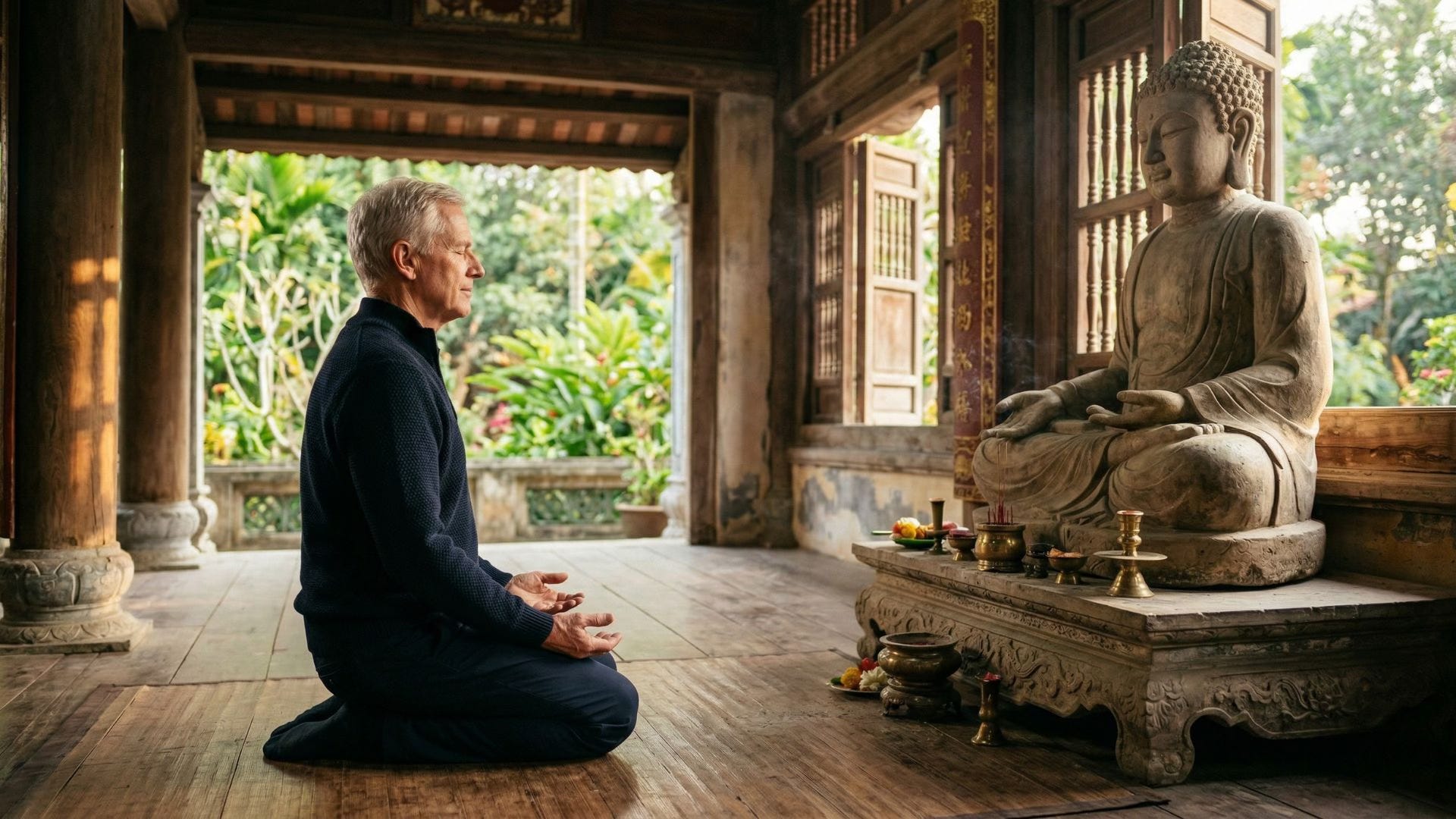
I knelt before a statue of Buddha in a temple in Vietnam, and something happened that I did not expect. I felt peace. Not the idea of peace. Not a theological understanding of peace. Something my body recognized before my mind could name it. The statue was serene. Eyes half-closed. Hands resting open. The entire posture radiated stillness, and without any instruction or doctrine, my nervous system responded. I softened. I settled. I was, for a moment, simply present.
And then a question rose in me that has not left since: Where is this experience in my own tradition? Where, in the faith I have followed my whole life, is the physical anchor that invites the body into the presence of the divine?
That question opened a door I was not expecting. What I found behind it was a pattern, one that stretches across centuries and continents and traditions. An original encounter with the sacred, something felt and embodied and alive, gets buried beneath layers of philosophy, politics, and institutional necessity, until the thing people practice bears only a faint resemblance to the thing that first set hearts on fire.
• • •
For centuries, the people of ancient Israel worshipped in a world rich with physical, embodied images of the divine. Archaeological sites across Israel and Judah have yielded thousands of small figurines associated with Asherah, the feminine dimension of the divine, found not only at public shrines, but in homes. The inscriptions at Kuntillet Ajrud, dated to around 800 BCE, invoke “Yahweh and his Asherah” as naturally as breath and body. The tabernacle itself was designed as a sensory experience: specific colors, specific scents, and at its center, the Shekinah glory, a visible, luminous presence.
Then came the Deuteronomistic reforms. The high places were destroyed. The Asherah poles were burned. The feminine face of God was removed. What had been a rich, multidimensional practice of worship was reduced to word, law, and abstraction.
Here is something I keep returning to: you do not write prohibition after prohibition against something that is not happening. Every command to destroy the images is, in a way, evidence that the images were beloved.
• • •
This is where the history becomes even more interesting to me personally, because the same pattern appears in every major tradition I have studied.
The earliest accounts of Christ describe someone who operated almost entirely through presence and embodied encounter. He touched lepers. He washed feet. He ate with people the religious establishment considered unclean. He wrote nothing down. What he left behind was an experience so alive that it spread across the Roman world within a generation. Within three centuries, the Empire had adopted Christianity as a political instrument, and the Council of Nicaea, convened by Emperor Constantine in 325 CE, began the long process of converting that experience into an approved creed.
The Buddha’s original instruction was radically immediate: sit down, pay attention to your breath, watch what arises without grasping or rejecting it. His final teaching, according to the Pali texts, was essentially this: be a lamp unto yourselves. Within a few centuries, competing schools had produced volumes of metaphysical categorization so complex that a person could spend a lifetime studying them and never once sit down to meditate.
Muhammad’s encounter with the divine in the cave on Mount Hira was overwhelmingly physical. He trembled, sweated, returned home shaken and wrapped in a cloak. The earliest message was startlingly simple: one God, care for the orphan and the widow, stand honestly before the divine. Within a generation of his death, the community had split over political succession, and the legal schools had begun constructing frameworks that governed everything from which hand to use when eating to how many steps to take entering a mosque.
I want to be careful here. Every one of these developments has its own integrity. But the pattern, as best I can see it, is unmistakable. Something alive and embodied is experienced by a human being. A community forms around it. The community becomes an institution. And over time, the system built to protect the fire becomes the thing that walls people off from it.
• • •
So what do we do with this?
I do not think the answer is to dismantle institutions or reject traditions. They carry real wisdom, real beauty, real continuity. But I do think we owe ourselves the honest question: How much of what I practice is the living thing, and how much is the system built around it?
The physical images in the ancient temple, the figurines held close in homes, the luminous presence between the cherubim, were never about idolatry, in my understanding. They were about landing. They gave the body a place to rest in the presence of something larger. They did not replace God. They helped people arrive.
What if the invitation has always been to come home? To settle? To let the body remember what the mind has been arguing about for centuries?
In my experience, the anchors were real. The felt, embodied, sensory experience of the divine was real, the way the ancient worshipper may have felt it standing before the Shekinah, or being touched and healed the way those who encountered Christ were touched and healed, or sitting in silence the way the Buddha sat, or trembling the way Muhammad trembled in the cave. It was not a primitive stage that needed to be outgrown. It was a wisdom that was taken, again and again, across traditions, across centuries, and that I believe we are free to recover.
That remembering is available to anyone. It does not require a temple, a tradition, or a system. It requires only the willingness to stop, to soften, and to let what has always been true prevail.
I invite you to ponder what it might mean, in your own life, in your own body, in your own quiet moments, to simply let the divine prevail.