

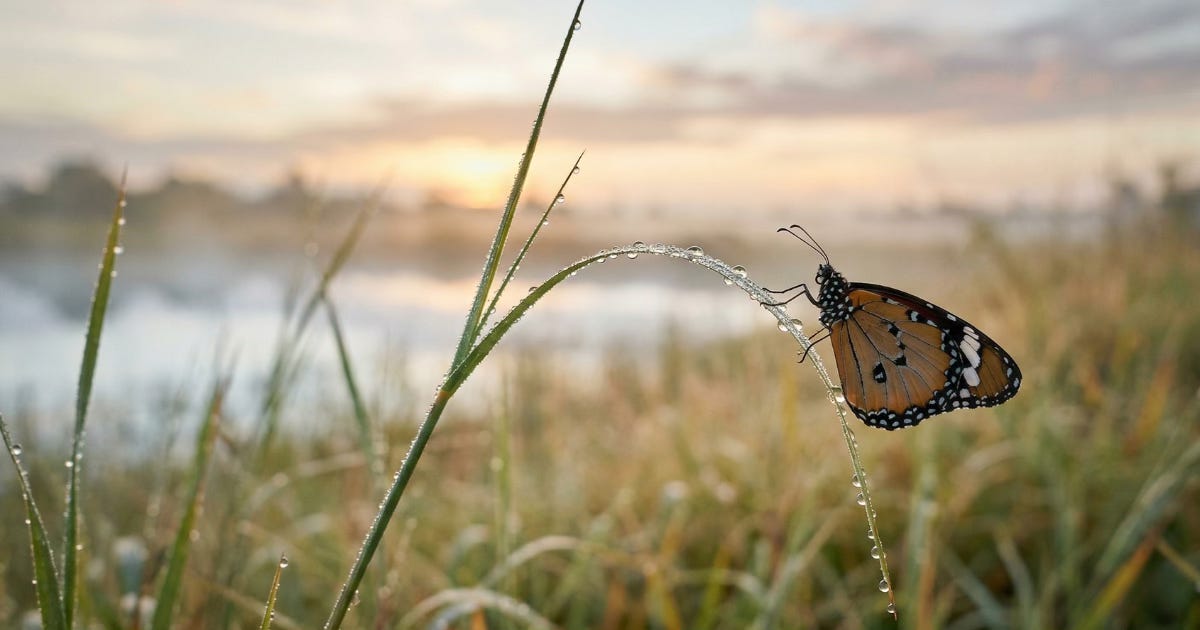
One morning I was walking through the fields near home, along a path that runs beside a pond. It was quiet. And at some point a butterfly appeared ahead of me — beautiful, with more colors than you might expect on an ordinary morning — moving freely above the grass, unhurried, with no particular destination. I stopped and watched it for a while. Just watched and enjoyed it.
And as I stood there, a metaphor came to mind. I found myself thinking about what that creature had been before it was that. About what the whole movement from one form to the other actually required of it. And somewhere in that quiet, standing next to the water, a question rose in me that has not fully left since.
There was a period before that morning, years before it, after I left dentistry, when I had more time than I knew what to do with. The practice had been successful, and then it was simply gone. The business consulting that followed was working in the technical sense — clients were coming, the work was getting done — but something about it never quite settled. I had met most of the goals I had set for myself over the years. From the outside it looked like arrival.
And yet something deeper sat untouched. A quiet ache I kept moving past, filling each gap with the next thing before it had time to speak.
I am not sure I would have named it as longing then. But that is probably what it was.
Some years later I spent a week on a retreat with Dr. Joe Dispenza. I went with the usual mixture of skepticism and quiet hope that most people bring to something like that — a person who had read enough to be suspicious of easy answers but was also, if I am being honest, tired of the noise that passed for resolution. What happened that week was not what I anticipated. By the time I left, something had genuinely shifted — not in the way a good conference shifts you, where the energy carries for a few days and then dissipates, but in a way that redirected the course of my life in the months and years that followed. The work I do now, the questions I ask, the way I understand what people are actually looking for when they say they want something more — all of it changed direction in that week. What I found there was not a new idea so much as a recognition of something I had apparently carried for a long time and kept walking past without stopping.
The butterfly does not become something it was not. I had heard this metaphor before. But as I stood there watching, I found myself wanting to understand the actual process, not just the idea of it. So I went and researched it. What I found was more remarkable than the metaphor I already knew.
The caterpillar does not study to become a butterfly. It does not strive toward flight or rehearse it or earn it. The blueprint was already inscribed, present long before the crawling started. What surfaces from the chrysalis was always already in the caterpillar. The metamorphosis surfaces it rather than creates it.
I find it interesting how long a true idea can live in the mind without actually touching anything.
What we are returning to is harder to name cleanly, and I want to be careful here. I am not a theologian. Different traditions have pointed toward it in different ways: the idea of a divine spark that predates the life we have constructed around it; the recognition of oneself as a child of God; the Buddhist sense of original nature, present before the conditioning layered itself on top. These are not identical things, and the distinctions between them matter. What they seem to share is the conviction that the deepest layer of who you are was not built. It was not earned through performance or assembled through achievement. It was there before the roles started accumulating.
The question worth sitting with is not what you are becoming. It is what you have always been beneath the noise.
Here is something I keep returning to about the butterfly metaphor. We tend to imagine metamorphosis as a clean and orderly process, the caterpillar going in and the butterfly coming out, the transformation moving in a straight line from one form to the next. It does not work that way. Inside the chrysalis, biologists have found that the caterpillar dissolves almost entirely into what they call imaginal soup, a formless cellular fluid, before any new structure begins to organize itself. There is a period, and it is not brief, where there is neither caterpillar nor butterfly. Just dissolution. The old form completely released before the new form is visible.
Most of us have lived something like that, even if we did not have that name for it.
The difficulty is that we want to rush past it. We want the emergence without the dissolving. We want clarity before the confusion has finished doing whatever confusion is actually supposed to do. One of the things I have noticed, both in my own experience and in the conversations I have had with people whose lives looked successful from a distance, is that the pressure to produce and perform does not leave much room for necessary dissolution. We fill the chrysalis with activity. We schedule it and optimize it and measure it, which is a very efficient way of never actually entering it.
Patience, in this context, is not a virtue in the usual sense. It is more like a willingness to let the process take the time it requires without declaring it failure because it is taking longer than expected. The caterpillar does not panic inside the chrysalis. It does not demand a timeline or produce evidence of progress. There is a kind of trust that operates in the dark, and I have found that some of the most important movement in my own life has happened in seasons that looked, from the outside, like stagnation.
What makes the return possible, as best I can see it, is not effort in the direction we are used to applying it. It is something closer to release. The setting down of what was never quite ours to begin with: the expectations inherited before we had the language to question them, the versions of ourselves built for someone else’s approval, the quiet exhaustion of performing competence in rooms where we felt, underneath it all, that we had not yet earned the right to simply be present.