

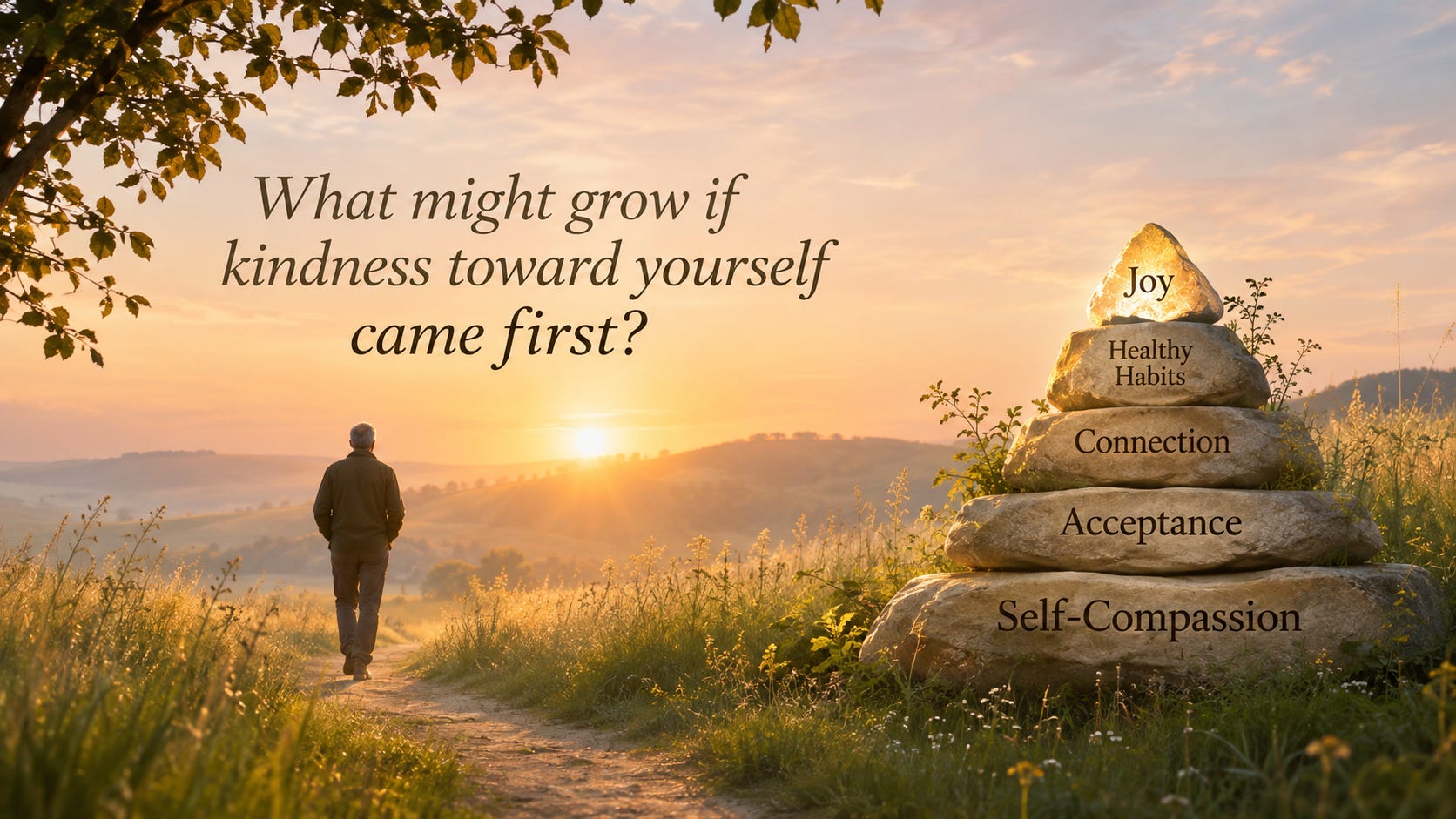
Dr. Samreen Mongillo has spent fifteen years as a physical therapist, and over that span she noticed a pattern she could not set aside. The patients who recovered well tended to share things that had little to do with their injuries: how they spoke to themselves, how they slept, whether they believed their bodies could heal. That observation became her book, The Path to Joy, which describes a kind of pyramid with joy at the top and self-compassion at the base, beneath mindset, physical health, connection, and daily habit. She came on Inspire Vision to talk about stress, gratitude, and the small choices that shape a life, and she told one story that makes the whole structure concrete. For years she had kept a modest gratitude practice, a line or two each morning and evening. When her mother was diagnosed with stomach cancer and died eight months later, that habit was one of the few things still standing.
The order of that pyramid is the part worth pressing on. Most people build it upside down.
The quiet pressure to become better
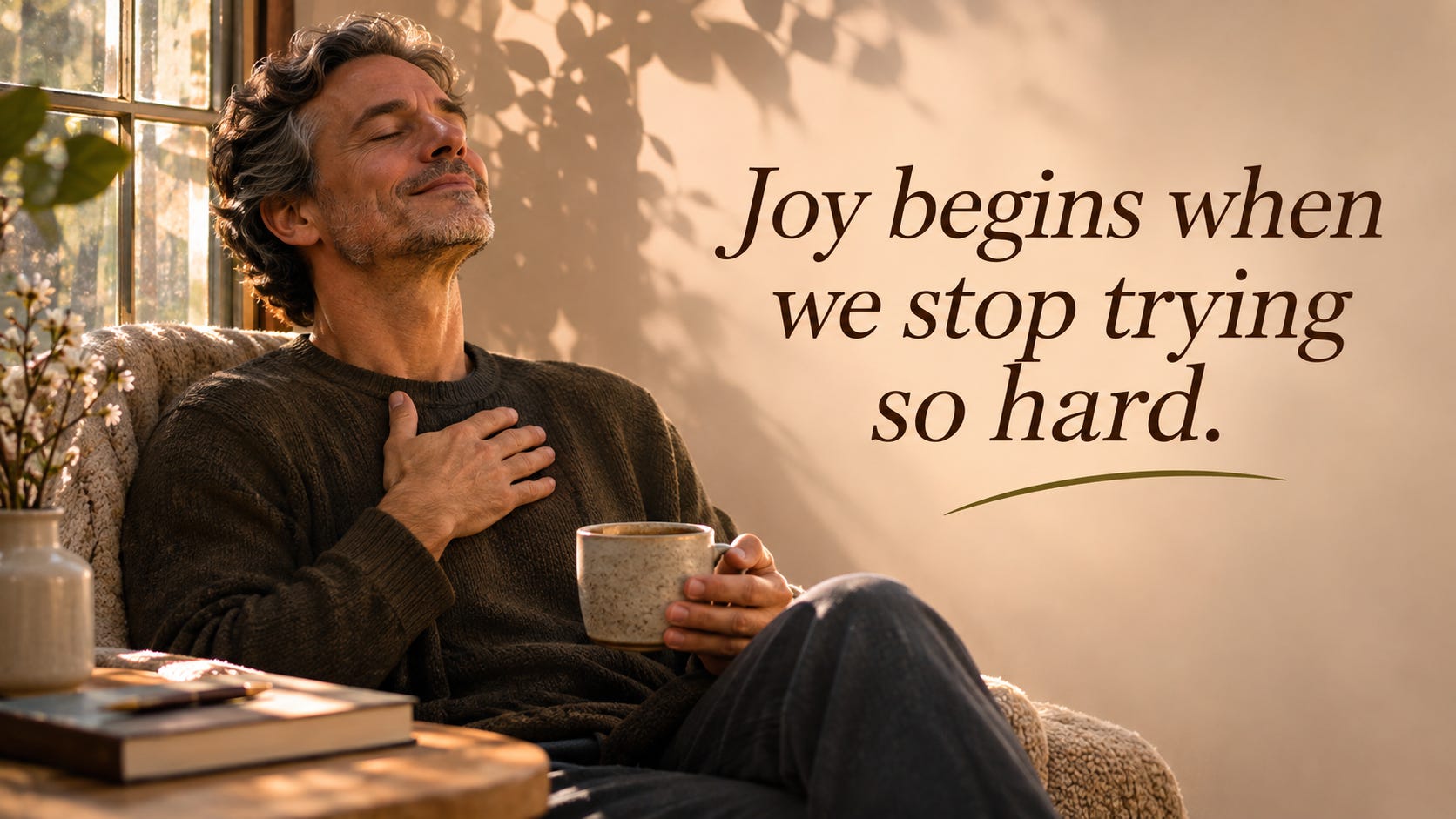
Most of us approach our own growth from the top. Joy is the goal, so we go looking for the practice, the teacher, the book, or the morning routine that will finally deliver it. Worthiness feels far away, and the natural response is to set goals that promise to close the distance. Even peace somehow becomes a thing to work harder at. Somewhere along the way the effort to become happier turns into another responsibility. The day opens with a list of what needs to get done and closes with an accounting of what did not. Even meditation becomes something to be good at.
There is something almost funny about it. The same habits of striving and self-measurement that created the restlessness get carried, fully intact, into the project of curing it. It is worth asking whether more effort is really what is missing, or whether something simpler has been forgotten: how to be with ourselves without needing to change anything first.
The body keeps its own record
Stress usually shows up in the body before it shows up in thought. The shoulders drift toward the ears. The jaw sets. The breath climbs out of the belly and into the upper chest, quick and shallow. An uncomfortable conversation ends at noon, and at ten that night the stomach is still responding as though it were happening. Plenty of people now wear a watch whose job includes reminding them to stand up, which says something about how far the body has drifted from view.
Not every symptom has an emotional explanation, and illness, injury, and pain deserve real medical attention. Still, emotional strain shapes how the body holds itself and how symptoms are felt. Most people understand this in theory while missing how often it is happening right now, in their own neck and shoulders.
Watch a newborn sleep and the breathing looks entirely different. The belly rises and falls, slowly, with no effort at all. Nobody had to teach the infant this, because it is where the body starts, the pattern it keeps when nothing is asking it to brace. Most adults have lived braced for so long that the tension feels like their natural state.
How much of what we call normal is actually the accumulated weight of experiences we never learned to put down?
In 1975 a Harvard cardiologist named Herbert Benson published a short book called The Relaxation Response. He had been studying people who practiced Transcendental Meditation, and he found that the measurable changes, the slower heart rate and slower breathing, did not seem to depend on the tradition surrounding the practice. A quiet place, a comfortable position, a word or the breath to rest attention on, and a willingness to let distracting thoughts pass were enough. What makes that finding worth sitting with is how little it asks. A few minutes. No special belief. The body already knows how to set the weight down, and mostly it needs to be allowed.
Who we learned to be
Most of us grew up learning how to be acceptable to the people around us. We figured out what earned approval and what invited criticism, which emotions were welcome at the dinner table and which were better kept private. Those lessons were useful. They built careers, raised families, and held marriages together. They also shaped, quietly, how we came to see ourselves. A child praised mainly for achievement can grow up believing achievement is the price of being valued. A child who had to keep the peace often becomes an adult who cannot say “I disagree” without feeling her heart rate climb. Someone expected to be strong may find vulnerability almost impossible to admit, even privately.
None of this happens on purpose. The voice that says “I can’t do this” or “I’m not going to get better” was usually installed early, by a parent, a teacher, a classroom of other children, and it runs so quietly that most people mistake it for their own opinion. Then, decades later, a life that looks perfectly reasonable from the outside does not feel comfortable from the inside, and the usual response is to add something. Another accomplishment, another program, another layer.
The breath held high in the chest and that voice in the head are often the same bracing, one carried in the body and one in the mind. Adding more layers rarely loosens either one, though noticing them sometimes can. The point of noticing is simply to see, without blame and without tearing anything apart, that the person we learned to become may not be the whole of who we are.
Starting at the base
Self-compassion may be the most misunderstood idea in this whole territory. People hear the word and picture excuse-making. They worry that accepting themselves will cost them their ambition, or their edge, or their sense of responsibility. Compassion leaves growth fully intact. What it changes is the relationship we have with ourselves while the growing happens.
Consider how most people treat a close friend who is having a terrible day. They do not open with a list of the friend’s failures or a reminder of unrealized potential. They sit down, listen, maybe offer a word of encouragement, and let the friend feel what they feel without demanding a solution by dinner. Then the same person stumbles, and the internal tone changes completely. You should be further along by now. You should know better. That gap between the kindness we offer others and the impatience we reserve for ourselves is one of the stranger features of being human.
Genesis describes humanity as made in the image of God. George Fox, who founded the Quakers in the 1650s, urged his followers to walk the world “answering that of God in every one.” Those are not identical claims, and the traditions around them differ in ways that matter. Both, however, place something worthy in a person before that person has accomplished anything at all. If that holds, self-compassion was never meant to be a reward waiting at the top of the pyramid, and it makes sense that it sits at the base, as the ground everything else stands on.
Acceptance, which is not giving up
Acceptance gets confused with resignation, and the confusion keeps a lot of people fighting their own lives. Resignation concludes that nothing can change, so why bother. The two can look alike from the outside, which is exactly why they get mixed up. Acceptance begins from what is actually true right now and treats it as a starting point.
The difference shows most clearly in a body that will not fully heal. Someone living with chronic pain or a neurological condition is usually carrying two separate things at once. There is the condition itself, which may not respond to positive thinking or more discipline. And there is the resistance to having the condition: the daily argument with reality, the anxiety that flares every time someone notices a tremor or asks whether you can still manage something that used to be easy. The first may be beyond anyone’s reach, while the second is where the real work happens. Loosening that resistance does not make the pain disappear, though it does end some of the fighting.
The same distinction reaches well beyond physical health. Grief can be acknowledged without becoming someone’s whole identity, and a disappointment can be honestly felt without turning into a verdict on an entire life. Acceptance leaves the door to change open and offers a calmer place to walk through it from.
Gratitude, honestly
Gratitude deserves the same honesty. We hear so much about it that it can start to sound like an obligation to find a silver lining in every loss. Some losses are simply devastating. A marriage ends badly. A diagnosis rearranges a family. There is no need to call those things blessings, and no need to rush toward gratitude before grief has had its time.
There is a practical reason the gratitude habit in that opening story held when so much else gave way. Habits are decisions made in advance. In a crisis there is almost no capacity left for deciding anything new. Sleep usually goes first, and appetite follows. Sitting in a hospital at two in the morning, nobody is in a position to begin a discipline they have never tried. What remains is whatever was already worn into the shape of the day.
This is also where gratitude gets complicated. Said to someone in fresh grief, “try to be grateful” can sound like a request to stop hurting. It can turn into one more performance, one more thing the grieving person is failing at. A gratitude that works only by shrinking the loss would be worth very little. So does the practice actually hold under real weight, or is it a fair weather habit wearing the costume of resilience?
The version that seems to hold is small. One thing, at the end of the day. A nurse who was kind. A friend who brought soup and had the sense not to stay too long. Half an hour when the pain eased. Gratitude at that scale sits beside the grief without arguing with it or trying to recast the tragedy as a gift, and it keeps one corner of the mind in practice at noticing what is still good. That matters more than it sounds when everything else is narrowing toward what has been lost.
A second kind of gratitude cannot be practiced at all. It arrives years later, uninvited, when someone looks back at the hardest season of their life and recognizes what it left behind. Often it is a deeper patience with other people’s pain, an ability to sit with someone who is grieving and offer presence without rushing to repair anything. No one can produce that in the middle of a loss, and no one should be asked to. The small evening practice may simply keep the door open long enough for it to come.
Small enough to last
When people set out to change their lives, the most common way it falls apart is ambition. Meditate for an hour, journal three pages, walk every morning, give up sugar, all beginning Monday. By the second week the whole structure has collapsed, and the collapse gets filed as evidence of personal failure. The pursuit of transformation quietly becomes one more source of the stress it was meant to relieve.
The practices that last tend to be almost embarrassingly modest. Twenty seconds with the first cup of coffee, feeling the warmth of the mug before drinking from it. A walk outside with nothing to accomplish on it. A few slow breaths before reaching for the phone, which for most people is awake well before they are. Listening to someone without rehearsing a reply. None of these sounds like much, and none of them will make an exciting story. Repeated over a year, they change the texture of a morning, and mornings add up to a life.
Even these can be turned into another program if we are not careful. There is always another book, another technique, another habit to master, and it is possible to examine a life so closely that we forget to live it. Reflection has real value. It is meant to help us live more freely, and some parts of life are simply meant to be experienced rather than analyzed.
Closer than we think
Joy tends to get placed at the far end of things: once the circumstances improve, once the relationship eases, when the body finally feels better, after we have become the person we think we are supposed to be. That placement makes it easy to miss the joy already within reach. It is quieter than happiness and it does not require the absence of difficulty. It looks more like being at ease with ourselves while life stays imperfect, enjoying a moment without needing it to become anything more, and remaining grateful and curious and fully alive while carrying questions that have no answers yet.
Healthy habits still matter. So does caring for the body, tending our relationships, and noticing the beliefs that shaped us. None of it has to be the condition for accepting ourselves. The pyramid makes the most sense read from the bottom up, with kindness toward ourselves laid down first and joy appearing at the top as something that grows from that ground, never as a prize finally earned.
Take a moment tonight to reflect on what it would mean to begin at the base. What might grow if kindness toward yourself came first?
© Dr. Doug Gulbrandsen