

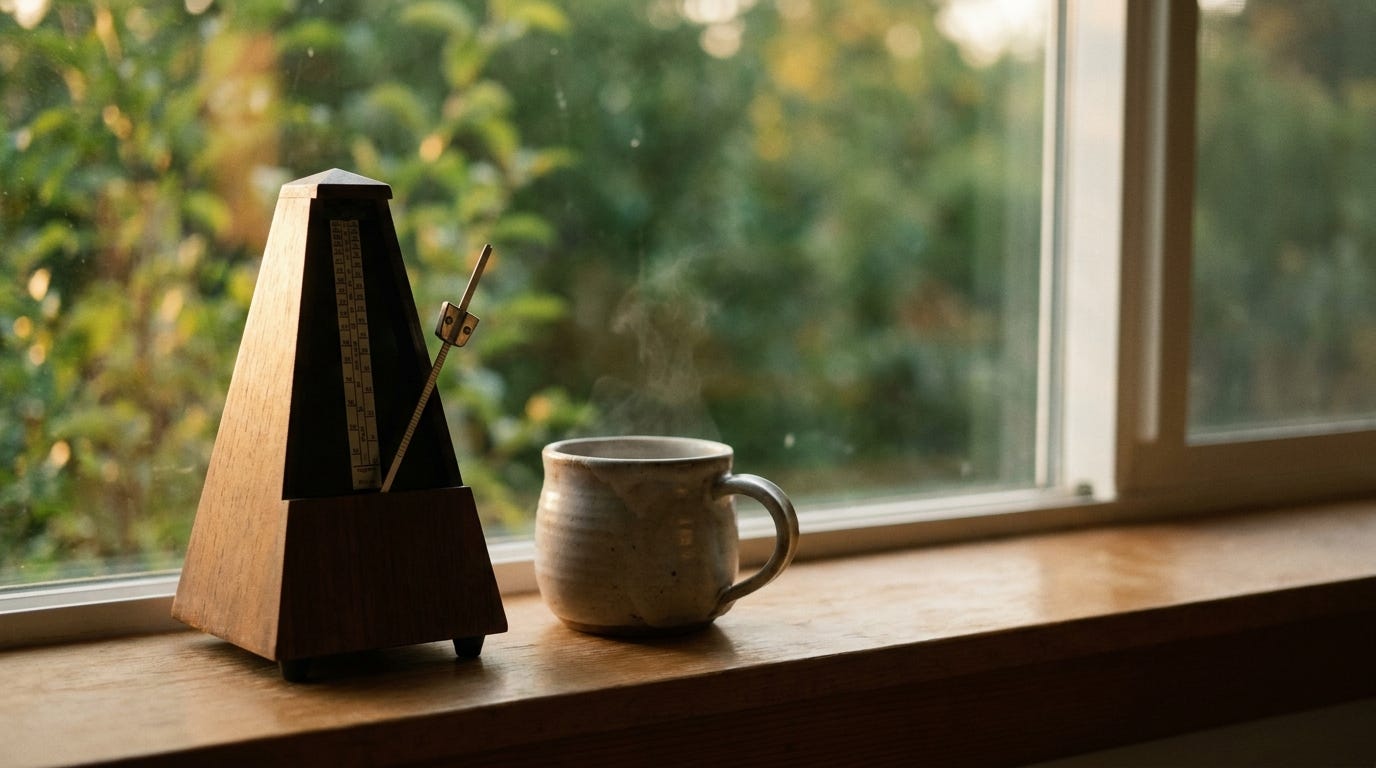
In a recent conversation on the podcast, Lynda Samphire, an intuitive guide and integration therapist who works with dream symbols, sound, and carefully held plant medicine practices, said something almost in passing that deserves to be slowed down and examined. We are out of rhythm, she said. Completely out of rhythm. And the work of returning is a remembering, a coming back to a tempo that was already ours. The conversation moved on. The idea should not.
Every person runs at a tempo that was there before anyone tried to adjust it. Watch two children in the same family. One narrates everything at full volume and full speed, already three ideas ahead of the sentence being spoken. The other watches quietly for an hour, then does the thing once, correctly. Neither child was taught this. It came installed. Then adulthood arrives and sets a single metronome for everyone: inbox pace, traffic pace, notification pace, the pace of whoever in the room talks fastest. Most adults have not heard their own native tempo in years, mostly because nothing in an ordinary week goes quiet long enough for it to become audible.
Pressure is where the truth surfaces. Someone cuts into traffic, and the words are out of the mouth before anything resembling a decision took place. That flash usually gets filed as a character flaw and apologized for. It is better understood as a reading. A nervous system in fight or flight does not respond, it reacts, and the reaction reports that the system has been running above its natural rhythm for a long time. The outburst itself is almost beside the point. The real information is the gap that went missing. Between what happens to us and what we do about it, there is supposed to be a beat, a small silence where choice lives. Under enough pressure, for enough years, the beat disappears, and a person becomes someone who is startled by their own voice in an argument.
What would it take to get the beat back?
That question is worth holding for a moment before reaching for the obvious answer, because the obvious answer, just slow down, turns out to be wrong more often than expected. Slowness is not the rhythm. Some people are genuinely quick. They decide in seconds, speak in bursts, and are completely settled while doing it, the way a good drummer is relaxed at speed. Other people move at a glacial pace and are white-knuckled the entire way, slow on the outside and racing underneath. So the diagnostic cannot be speed. The better question is ownership: is this tempo mine, or was it imposed? A settled system can run quickly, while a braced system stays fast on the inside even when the body is standing still. The task was never to match some universally approved calm. The task is to find the pace the system actually recognizes as home, which for some readers will be slower than their life currently allows, and for a few will honestly be faster.
The practices, whatever they are, work like metronomes for finding that pace again. Stillness returns some people to themselves. Movement returns others, the long walk, the swim, the kitchen dancing that no one is meant to see. And underneath all of it sits the one rhythm nobody invented and nobody can perform: sleep. The body keeps its own time all night, cycling through dream states on a schedule older than any calendar, and it offers a small daily doorway back. Lingering a few extra minutes on waking, before the day’s metronome starts, is one of the few moments when the native tempo is still audible. It costs nothing. Almost no one does it. There is something quietly funny about that, given how much money people will spend to feel regulated by noon. No one has ever settled a nervous system on command, least of all their own, but nearly everyone has felt it settle on its own terms in the minute before fully waking, and then gotten up quickly enough to miss it.

I invite you to spend the next few days noticing your own beat. Notice the pace you walk when there is nowhere to be, the tempo of an unscheduled morning, the moments when the gap between what happens and what you do goes missing. And consider what it might mean that the rhythm you are looking for is not something to build, but something to remember.
For the episode with Lynda Samphire click here.
© Dr. Doug Gulbrandsen