

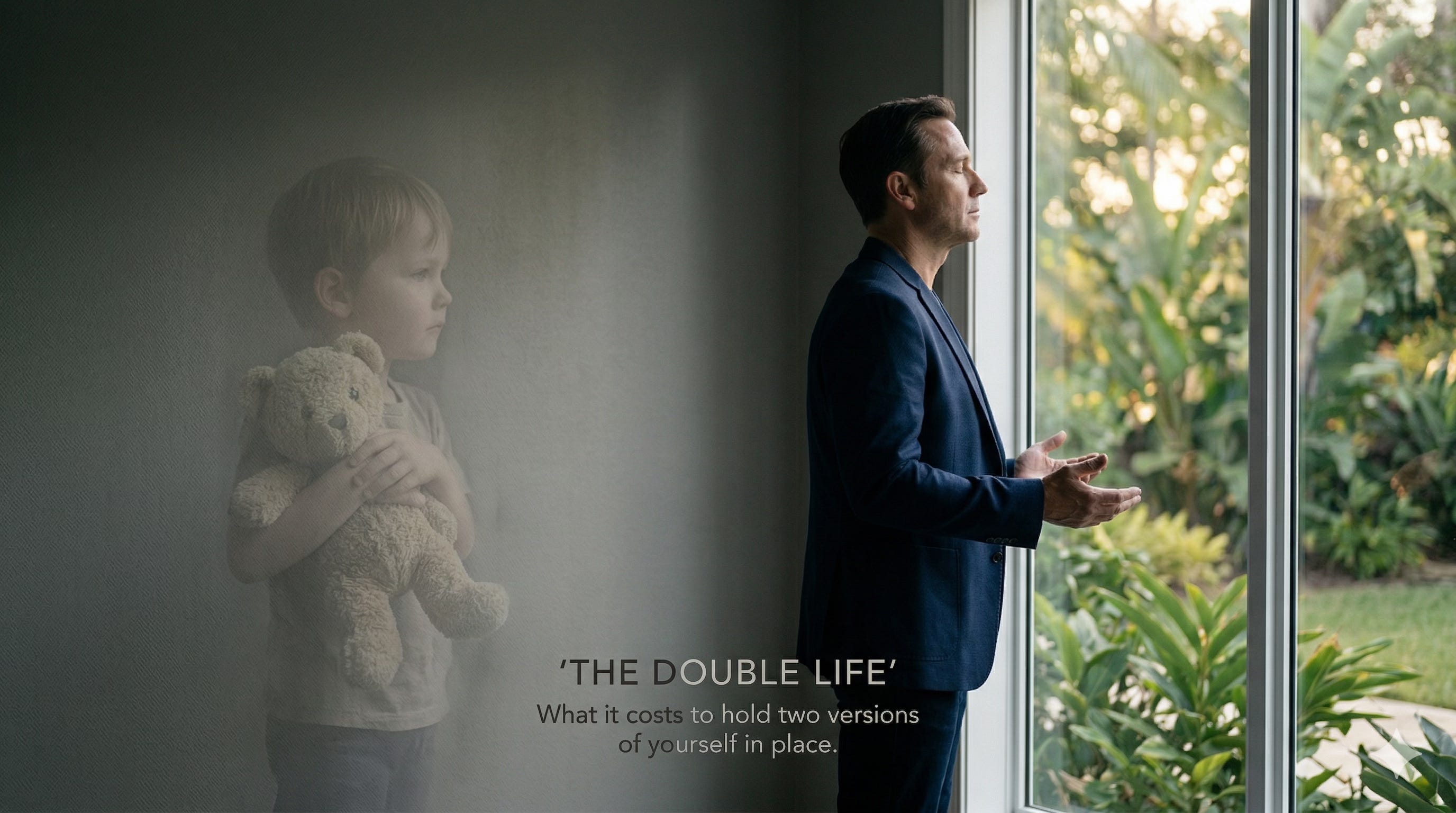
Mark Wigginton is a licensed counselor and board certified coach who works with high-performing men navigating midlife transition. He came on the podcast and named something with a kind of plainness that caught my attention: the double life. He was describing his own experience — successful in sales, performing well by every external measure, and hollow inside. He also said something near the end worth holding: every day, you have the chance to start again.
Those two ideas belong together. Here is why.
The double life is not dishonesty. Not exactly. It starts as competence. You learn early what the world rewards — composure, productivity, strength — and you get good at delivering it. You learn which emotions are acceptable and which ones need to be stored somewhere nobody can see. For a while, this works. The career advances. The surface holds. And somewhere underneath, a five-year-old is still driving the bus.
That image is worth pausing on. The adult is out front, handling meetings and mortgages, but the unresolved things from childhood — the chaos, the absence, the moments no one helped you name — are still pulling strings. The pattern does not announce itself. It just shows up as restlessness, as the drink that takes the edge off, as twenty jobs in fifteen years, as the inability to sit still in a life that looks fine from the outside.
The model of masculinity makes this harder to interrupt. The generation that grew up watching John Wayne learned that strength meant not needing anyone. The generation watching John Wick is learning the same thing with better choreography. The message has not changed much: perform, endure, do not talk about what is going on inside. And so the gap between the surface and the interior widens quietly, year after year, until something breaks — a health crisis, a relapse, a relationship that finally runs out of patience.
What keeps the double life in place is often perfectionism. And perfectionism, it turns out, may rest on a mistranslation. The word rendered as “perfect” in English scripture traces back to a Hebrew word that meant something closer to “complete.” Not flawless. Whole. That is a very different instruction. In Thai, the closest word is som-bun-baep — som-bun meaning complete or full, and baep meaning model or pattern. Even the language builds its version of perfection from the idea of fitting a complete pattern, not from the idea of being without flaw. Which raises a question worth sitting with: how much of the pressure to perform flawlessly is built into the culture rather than into the nature of things?
The fear is that if you stop performing, everything collapses. That if people saw the interior — the doubt, the fatigue, the old wounds still running the show — they would not know what to do with you. But collapse is not actually what happens when the gap begins to close. What happens is quieter than that. It looks like giving yourself the grace to be imperfect and still keep going.
There is a concept in recovery called harm reduction. It moves away from the binary of total abstinence or total failure and allows a person to define their own goals. The original message of the twelve-step programs, before they calcified into something more rigid, was simpler than most people realize: do your best today, and if you fall short, start again tomorrow. That is not a lowering of standards. It is a recognition that the demand for perfection is often the thing that keeps people stuck — not the thing that sets them free.
The three-part model of ego is useful here. There is the bully — the performer, the one out front making it happen. Behind the bully, there is the scared child — the five-year-old, the unresolved wound, the one pulling strings. And then there is the identity, the actual self, trying to mediate between the two. The work is not to destroy one part or rescue another. The work is integration. Letting the identity come forward. Becoming, rather than endlessly performing.
Fathers show up in this conversation more than you might expect. The absence of a father — physical or emotional — shapes how men learn to move through the world. When the model is missing, the culture fills the gap with characters who do not need anyone. And the pattern repeats across generations. Fathers behind bars grieving the loss of connection with their sons. Their sons in juvenile programs, burning with anger about the absence. Both sides of the same wound, separated by a fence, each unaware the other is talking about the same loss.
But reconciliation does not require perfection either. Sometimes it looks like a box of old photographs someone kept for thirty years without ever saying why — photos from a time before the relationship even existed, tucked into a plastic bag among the private things. Sometimes the relationship is not the one either person wanted, but it is the one they had, and they found a way to make it work. And sometimes the recognition arrives late but still arrives: he was doing the best he could with the resources he had. Just like you have been.
That is where the second idea comes in. Beginning again is not a dramatic event. It is not the moment you check into rehab or quit your job or move to another country. Those things happen, and sometimes they matter enormously. But the deeper practice is smaller than that. It is waking up on an ordinary morning and choosing presence over performance. It is noticing the gap between the surface and the interior and deciding, just for today, not to widen it.
Every day you have the chance to start again. Not because yesterday did not count. But because the demand to get it right permanently, once and for all, may be the very thing keeping the double life running.
What would it mean to let that demand go? Not all at once. Not perfectly. Just enough to find out what is underneath the performance, and whether it might be closer to whole than you thought.
For those interested, here is a link to the podcast: