

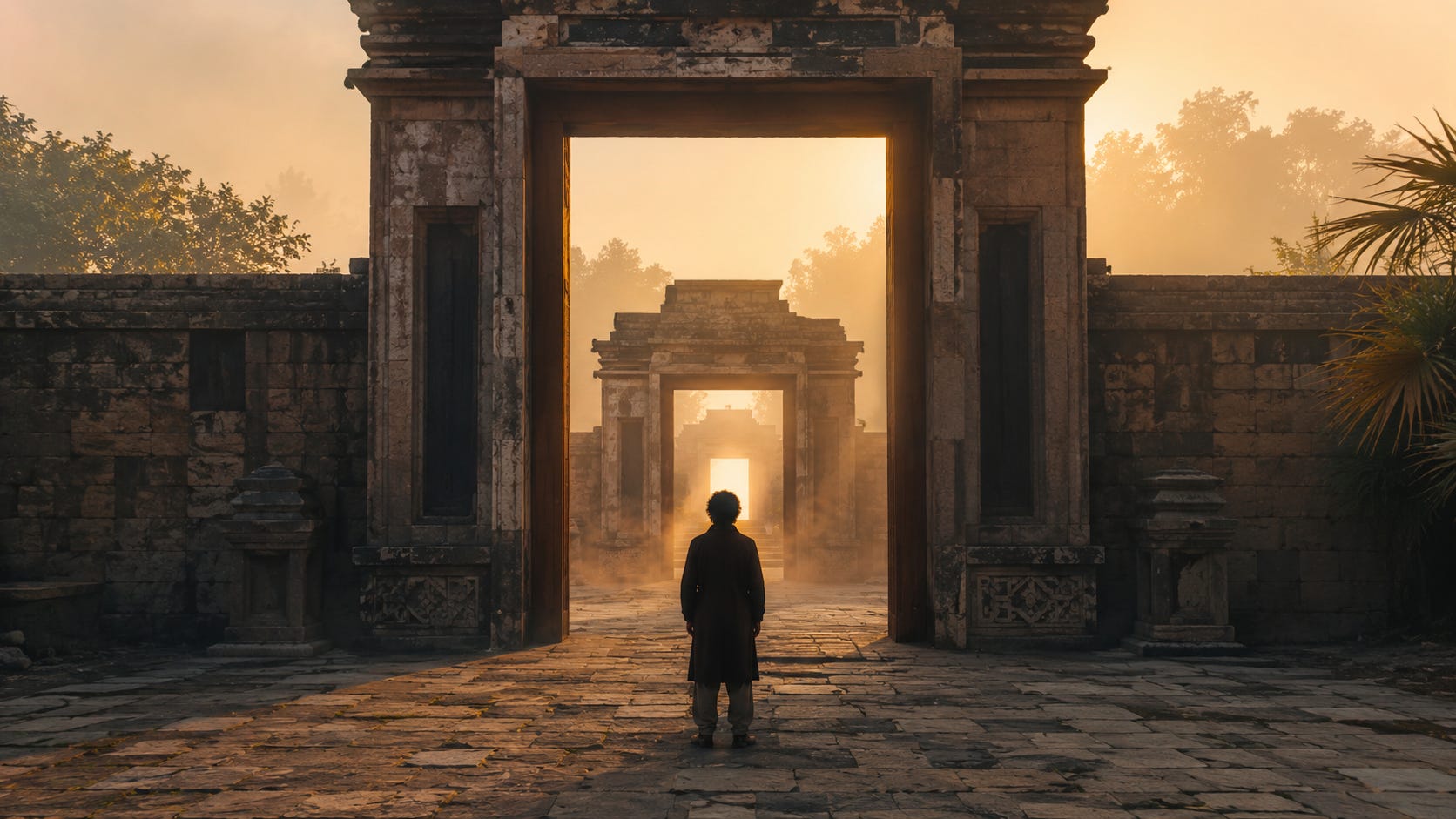
This week I visited several temple compounds here in Bali, and I kept noticing the same structural pattern at each one. You enter through a split gate, the candi bentar, into an outer courtyard that anyone can access. A second gate leads into a middle courtyard, more restricted. And then a third, innermost space, the most sacred, reserved for ceremonial worship and active ritual. I found myself curious enough to research it afterward, and what I found is that these three zones are not arbitrary. Each section represents a different degree of holiness, a movement from the ordinary world toward increasingly sacred ground. The Balinese understand the outer courtyard as the space of everyday human activity. The middle courtyard is transitional, a place of preparation and offering. The inner sanctuary is where the divine actually dwells.
What piqued my curiosity was not Bali in particular. It was the fact that I had seen or was aware of this concept before, in completely different traditions, in different parts of the world.
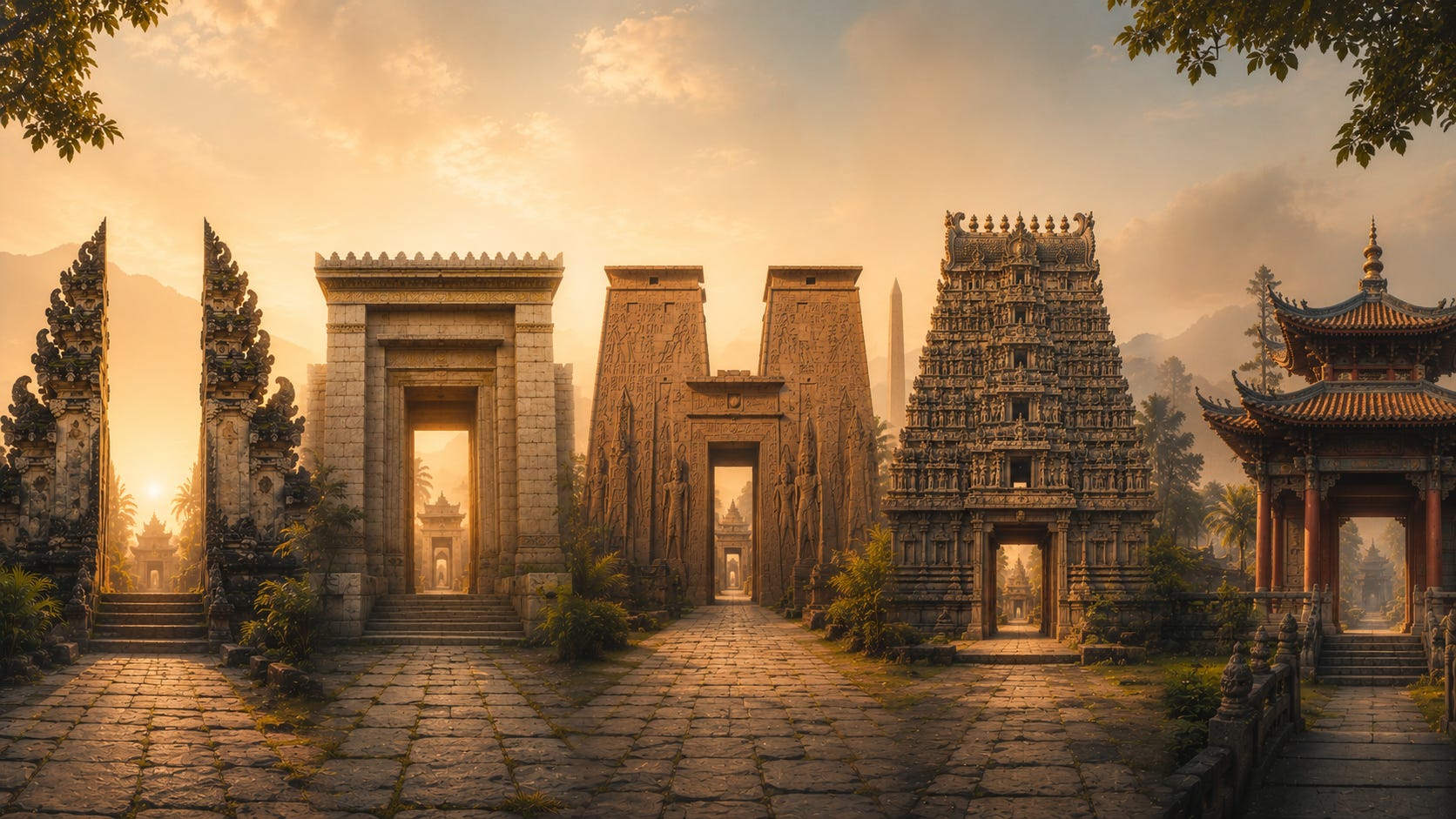
The ancient Temple of Jerusalem operated on the same logic. An outer court open to all. Then the Court of the Priests. Then the Holy Place. And finally the Holy of Holies, a small, darkened chamber where, according to the text, God’s presence dwelled and where only the high priest could enter, once a year, on the Day of Atonement. Egyptian temples at Karnak and Luxor follow an almost identical sequence, narrowing from massive public pylons down to a dim inner sanctuary housing the image of the god. Hindu temples across South India move from an outer gopuram toward an innermost garbhagriha, literally “womb chamber,” where the deity resides. The pattern appears in Buddhist pagoda complexes, in great mosque compounds, in Mesoamerican sacred precincts. These traditions had no meaningful contact with one another, and yet they kept arriving at the same architectural answer.
This is a question I find genuinely worth sitting with: why do so many separate civilizations, across centuries and continents, organize the approach to the sacred in the same way?
One possibility is convergent spiritual instinct. Human beings everywhere seek transcendence, and perhaps similar longings produce similar designs. That reading holds, as far as it goes. But there is another possibility I find more interesting to press on. Many traditions carry stories of a lost intimacy with the divine, a time when the sacred was not distant but immediate. The Garden of Eden. The sacred mountain. The primordial dwelling place at the center of creation. What if sacred architecture was not merely symbolic but commemorative? What if the progression from outer courtyard to inner sanctuary was preserving, in stone and gate and threshold, a memory of something the human heart has always known it had lost?
History cannot answer that with certainty. What it can tell us is that people kept building the journey anyway, across cultures that never spoke to each other, for thousands of years.
What these temples teach, at their deepest level, is not theology in the propositional sense. It is something the body absorbs before the mind has a chance to organize it. Walking through a gate, crossing a courtyard, entering a narrower and more interior space: the worshipper is not merely hearing about spiritual movement. She is physically enacting it. The architecture is the lesson, and the lesson is in the sequence.
The outer courtyard represents ordinary life with its demands and horizontal preoccupations. The intermediate spaces require something of you, a slowing, a preparation, the setting down of what you carried in. The innermost sanctuary represents what all of it was pointing toward: communion with the divine, or in Buddhist terms, a stillness so complete it dissolves the ordinary boundary between self and awareness.
What strikes me here is the insistence on preparation. You do not walk straight from the street into the presence. Something is asked of you first. I find that worth considering, not as a theological claim about merit or unworthiness, but as an honest statement about what the human heart actually needs in order to arrive somewhere real. The gate is not an obstacle. It is part of the teaching.
What I find remarkable is that the same journey encoded in this architecture also appears in the biographies of the figures these traditions center on. Not as metaphor. As lived sequence.
Christianity’s Gospels portray Christ’s life as explicitly progressive. Luke states plainly that Jesus “grew in wisdom and stature, and in favor with God and man.” That is not a statement about omniscience. It is a statement about development. The author of Hebrews presses further: “Although he was a son, he learned obedience through what he suffered.” And John opens his gospel with the phrase “grace upon grace,” not grace delivered once and complete, but an accumulation, one layer deepening into the next. If Christ himself moved through stages of deepening, from understanding to greater understanding, from alignment to fuller alignment with the divine will, then his life is the temple journey enacted in human form. He did not begin where he ended. The Gospels bear this out in how he taught. He did not distribute doctrinal positions and ask people to agree. He invited them into a process. Leave this behind. Come, follow. The journey is the teaching.
Buddhism’s founding story follows the same progression. Siddhartha Gautama was born into the Shakya clan in what is now Nepal, sheltered by his father from any sight of suffering or impermanence. The palace was a kind of outer courtyard, comfortable and self-contained but deliberately sealed from what lay beyond its walls. When Siddhartha encountered what the Pali texts call the four sights, an old man, a sick man, a corpse, and a wandering renunciant, he crossed his first threshold. He left the palace, left his wife and newborn son, and entered the middle courtyard of genuine searching. What followed was years of preparation. He studied under two accomplished meditation teachers, Alara Kalama and Uddaka Ramaputta, mastering their systems and finding them insufficient. He then joined five ascetics and practiced severe self-mortification before recognizing that extreme as another dead end. And then he sat beneath a fig tree at Bodh Gaya and did not rise until the innermost sanctuary had opened. The Majjhima Nikaya describes that final night as a progressive deepening through stages of meditation, each one more interior than the last, until what remained was not seeking at all. The Noble Eightfold Path he then spent forty-five years teaching was not a shortcut to that place. It was a careful map of the same journey inward.
The Bhagavad Gita, one of Hinduism’s most revered texts, opens at what may be the most dramatic outer courtyard in world literature. Arjuna stands between two armies on the field of Kurukshetra, a warrior at the height of his powers, and collapses. He drops his bow. His body trembles. He cannot see any purpose in what he is about to do. By every external measure he is prepared. Internally he is entirely lost. That collapse is his first gate. What follows across eighteen chapters is Krishna walking Arjuna progressively inward, not through a single declaration but through successive layers of understanding: the nature of the self that does not die, the nature of action performed without attachment to its fruits, the nature of devotion, and finally the nature of complete surrender to the divine will. Each teaching prepares the ground for the next. By the final chapter, Arjuna says simply: “My delusion is destroyed.” He does not say it in chapter one, because he could not have. The journey was the preparation, and the preparation was the point.
Three traditions. Three figures. Three lives that mirror the architecture their traditions built.
Here is something I keep contemplating. Across several of the world’s major traditions, something similar has happened over time. The long, progressive path toward the sacred, the kind encoded in temple architecture, the kind that assumes movement and preparation and genuine inner change, has in various streams been compressed into a single decisive act.
In significant portions of Protestant Christianity, particularly traditions shaped by the revival movements of the 18th and 19th centuries, salvation came to be understood primarily as a moment: a verbal declaration, a sincere prayer, an acceptance of Christ’s atoning work. The inward transformation that the early church understood as the ongoing substance of the Christian life was reframed, in many of these traditions, as simply the consequence of that single moment rather than an ongoing journey toward it.
A recognizable parallel developed within Buddhism. In certain devotional streams, particularly those emphasizing complete reliance on divine grace rather than personal practice, the idea emerged that a single sincere act of faith and surrender was sufficient for liberation. The elaborate progressive frameworks that characterized classical Buddhist practice, the careful stages of meditation, the years of ethical refinement, the mapped sequence of deepening awareness, receded in importance. The single act of turning toward the divine displaced the long walk through the courtyards.
Within popular Hinduism, similar tendencies appeared. Certain acts, a pilgrimage completed, a sacred river entered, a moment of total surrender to the divine, came to be understood in some traditions as capable of conferring liberation regardless of the spiritual development preceding them. The more rigorous philosophical schools never abandoned the progressive model, but at the popular level the compression was real.
I want to be careful here, because I am drawing on general historical reading rather than specialized scholarship in any of these traditions, and the picture in each case is more nuanced than a brief summary can carry. But the broad pattern seems worth naming honestly. This appears to be a recurring human tendency rather than a failure unique to any one tradition. When a path matures and spreads to a popular level, the long progressive journey tends to get compressed into something more immediate and accessible. Which is understandable. The long walk through the courtyards is demanding. The single act at the gate is not.
What gets lost in that compression is the question I find worth sitting with. When salvation, or liberation, or enlightenment becomes entirely located in a single moment, the question of what happens next, of becoming, of the slow movement from outer courtyard to inner sanctuary, loses its urgency. And the lives of the very figures these traditions are built around, Christ growing in wisdom and stature, Siddhartha sitting beneath the Bodhi tree only after years of genuine preparation, Arjuna arriving at surrender only after eighteen chapters of inner work, suggest that the compression misses something essential about how the journey actually moves.
The gate gets mistaken for the sanctuary.
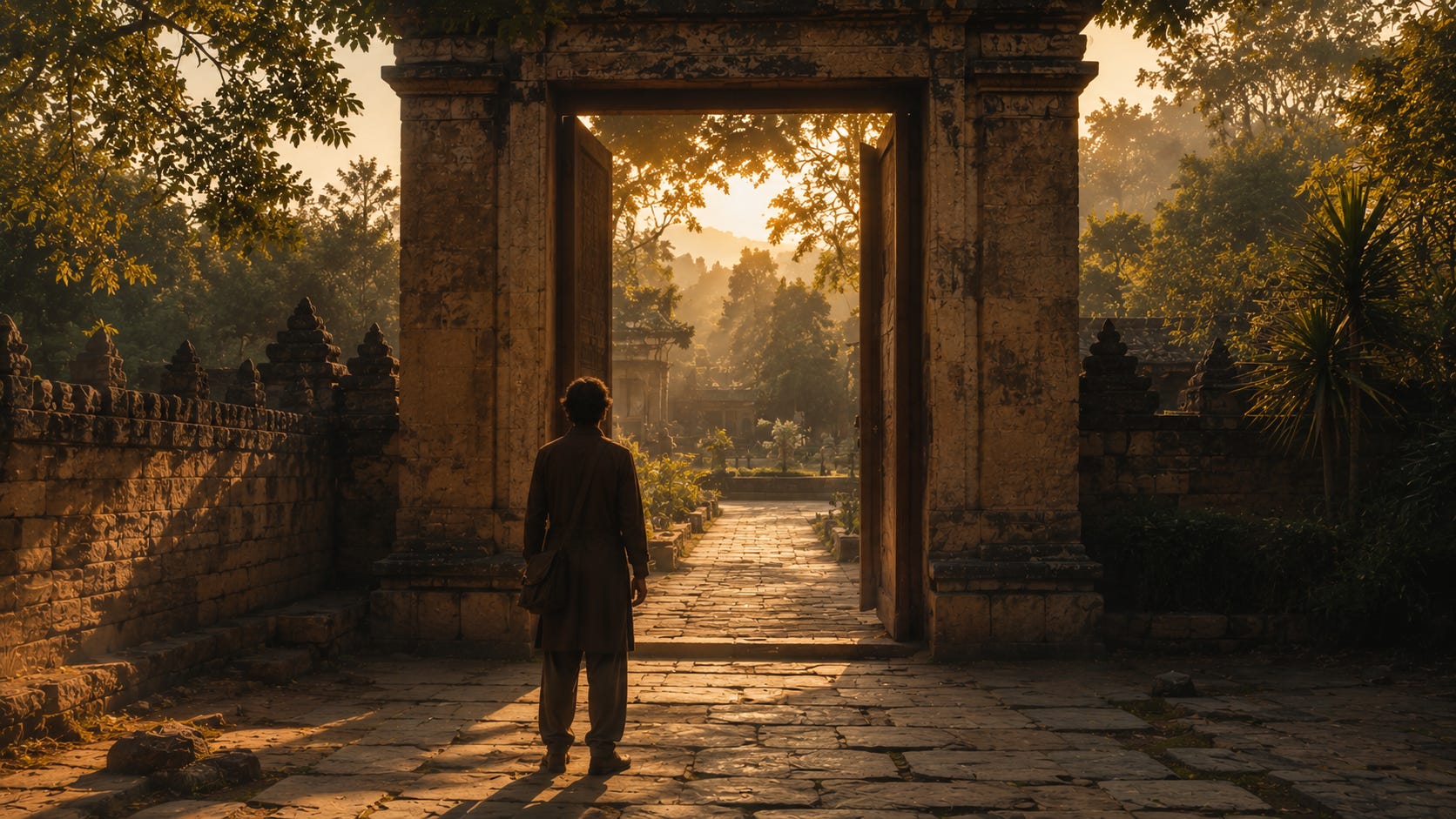
Paul’s phrase in 2 Corinthians is worth staying with here. He describes believers being transformed “from glory to glory,” the same direction as the temple journey, the same accumulation, the same sense that you do not arrive once but continue moving toward something that keeps expanding. The Balinese temple builder and the Jerusalem priest and the South Indian architect and the apostle writing from a Roman prison may all be pointing at the same truth: transformation does not happen all at once. It happens progressively, through thresholds willingly crossed, through preparation honestly undertaken, through the long movement from outer courtyard to inner sanctuary.
The buildings have been making this argument for a very long time. I find it worth pondering that so many people, in so many places, kept building it the same way.
What I invite you to consider is whether there is a threshold in your own life you have been approaching without quite crossing, and what it might mean, in your own body, your own daily practice, your own quiet moments, to take one more step inward.
____________________________________________________________________________
© Dr. Douglas Gulbrandsen