

Taking an honest step in a new direction requires knowing where you are standing. That is harder than it sounds.
Most people who feel misaligned with their lives can identify the discomfort. Fewer can locate it precisely enough to do anything useful with it. They sense that something is off, but the signal is diffuse. So they reach for the most visible thing — the job, the relationship, the city — and adjust it. Sometimes that helps. Often, six months later, the same feeling returns in a new setting. Which suggests the source was somewhere deeper than the thing they moved.
That is what a map is for.
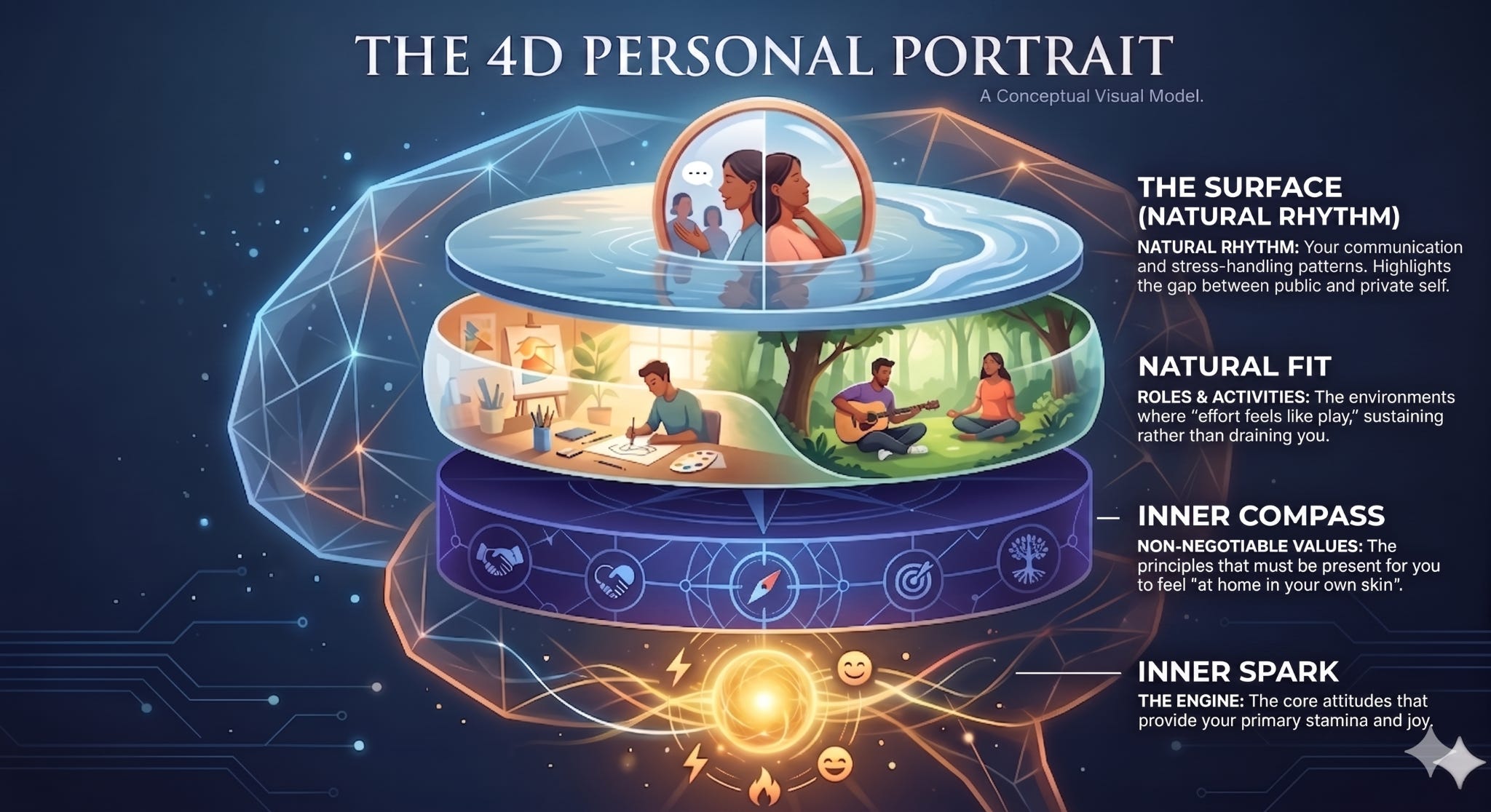
The model I work with is called the 4D Personal Portrait. I am a licensed and certified practitioner with PeopleKeys, and it is an adaptation of their assessment framework — a rigorous tool developed originally for organizational use that I have worked to bring closer to the questions individuals are actually asking. What makes it useful is not the categories themselves but the way they are arranged: not as a flat inventory of traits, but as a series of concentric layers, each one deeper and more foundational than the last. You could think of them as a ladder that descends from the most visible layer of your experience down to the most elemental.
The reason that structure matters is emotional, not just analytical. The misalignment you feel at the surface of your life is often not caused at the surface. Something deeper is sending the signal. The work is learning to follow it inward rather than managing it at the layer where it first becomes visible.
The outermost layer is the Surface — your natural communication style and your default responses under stress. This is the layer other people encounter, and it is often where misalignment first registers as conflict. The friction in a recurring argument, the exhaustion after a week of interactions that should have been ordinary — these often originate here. Not because something is wrong with you, but because your natural rhythm and the rhythm of your environment are pulling in different directions.
One layer down is Natural Fit — the environments and types of work where effort tends to sustain you rather than draw you down. This is more specific than asking what you love. It is about the actual texture of your days: whether the structure of what you do gives something back or quietly costs you over time. In my experience, people who feel chronically depleted are often working hard at things they are technically capable of doing — just in environments that run against their grain. Capability and fit are not the same thing.
Deeper still is the Inner Compass — the values that function as non-negotiables. These are the principles that, when violated, produce not just discomfort but a particular kind of internal wrongness. When the Compass is clear, a difficult decision often becomes simpler — not easy, but honest. When it is murky or suppressed, you find yourself agreeing to things and then quietly resenting them. That resentment is information. It is the Compass trying to surface.
At the center is the Inner Spark — the core attitudes and intrinsic motivations that provide stamina independent of external reward. This is where I find the most interesting questions, and the ones that take the longest to answer honestly. The Spark is not about what you want to achieve. It is about what keeps you curious and alive when achievement is not on the table. When it is engaged, a hard day still feels like yours. When it is not, even an easy day can feel hollow.
Here is what I keep noticing: most people try to solve a deep problem at the wrong layer. They adjust what is visible without examining what is foundational. A new situation gets pursued without any real reckoning with what the Compass or the Spark actually need. The exhaustion returns because the source was never addressed — only the symptom was relocated.
Over the next four articles, we will descend through these layers one at a time — beginning with the Surface, where most of the friction first becomes visible, and working inward from there. Each layer reveals something the one above it cannot.
What I keep returning to, before we begin: the discomfort you have been managing at the surface — what if it has been trying to tell you something about a layer you have not yet looked at or understood?
____________________________________________________________________________
Concepts drawn from the 4D Personal Portrait, a personal-first adaptation of the 4D Report by PeopleKeys®. As a licensed practitioner, I have modified this framework to help individuals move beyond behavioral data and toward deep personal alignment.