

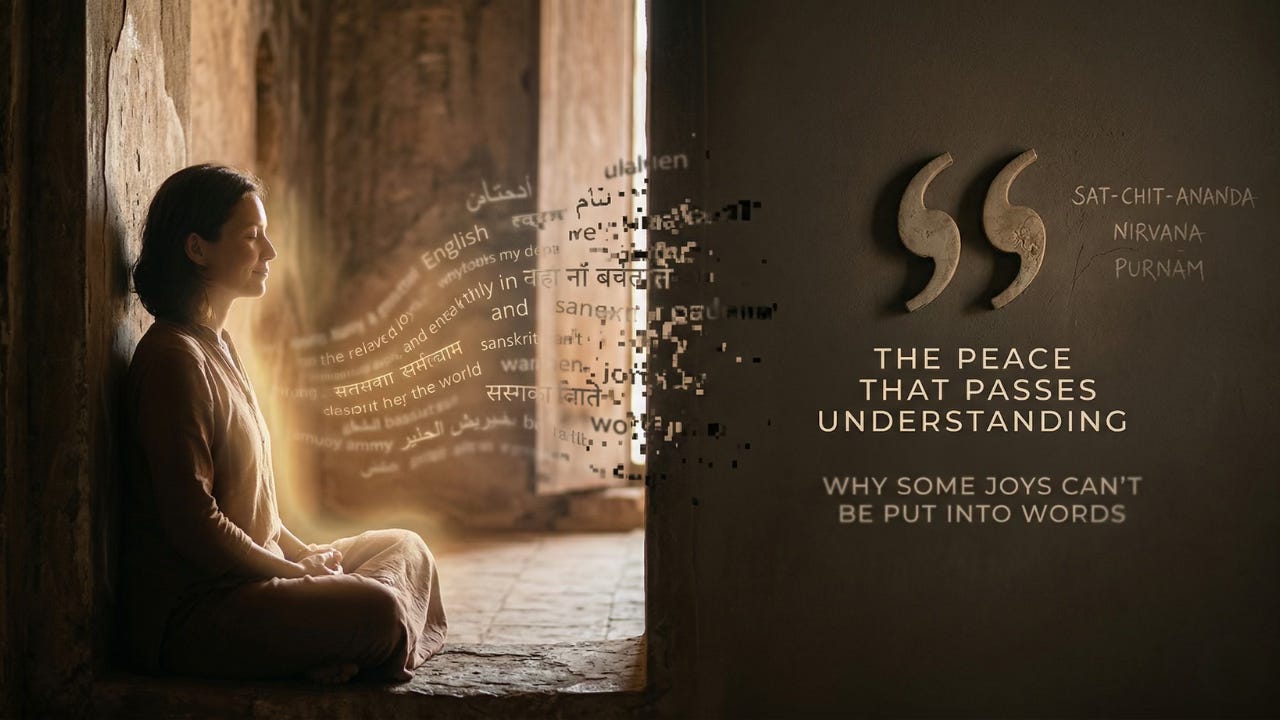
My son sent me a Marco Polo recently. That is how we stay in contact. He is thirteen hours behind me, which means our conversations arrive in each other’s mornings like small dispatches from a parallel day. In the middle of this particular message, he stopped. He was trying to describe something he had been experiencing, a kind of peace, and I watched him reach for the words, pause, and reach again. What he finally said was something close to: I don’t know how to describe this. There just aren’t words for it.
Months before that conversation, I was lying next to my wife one evening, my arms around her, and something settled over me that I have not been able to name since. A stillness that carried both connection and joy inside it. I did not reach for language. I just stayed there.
I kept returning to both of those moments. My son reaching for language in a video message, and a quiet evening close to home where language did not seem like what was needed. Both were running up against a genuine limit, one that some of the oldest contemplative traditions in human history have been quietly naming for centuries.
In linguistics, there is a concept sometimes called the semantic gap: the space between a label and the felt reality it is meant to carry. A word like “love” does not love anyone. It is a compressed symbol pointing toward something the body and heart know in a register that language cannot fully enter. They are the description of warmth, and the warmth itself has to be felt somewhere the description cannot go.
What strikes me about this gap is that in several of the oldest contemplative traditions, it is not a problem to be solved. It is a central theological claim. These interior states, the deepest ones, the ones that arrive in stillness or in grief or in moments of unexpected grace, are considered beyond the reach of language. The difficulty of description points to the actual shape of the thing being described. By their very nature, these states exist outside what language can describe.
Buddhism approaches this with what scholars call via negativa, defining by negation. When the Buddha was pressed to describe Nirvana, he often named what it was not: the extinction of craving, the cessation of suffering. He was being precise. The Dhammapada, one of the earliest collections of his teachings, makes this claim directly: there is no happiness higher than peace. What he called Parama Sukha, supreme peace, is described not as a heightened state but as something closer to relief. The metaphor he reached for was carrying a stone. Imagine you have had a heavy weight in your arms for so long that you no longer notice the effort. Nirvana is the moment you set it down. What you feel afterward is the coolness and ease that come when the burden is simply gone, not exhilaration exactly, but something quieter and more permanent.
The Hindu philosophical tradition, particularly within the school of Advaita Vedanta, approaches this from a different angle. The term used there is Sat-Chit-Ananda: being, consciousness, and bliss. The third element, Ananda, is described as objectless joy. Most of the joy we experience has a cause, a conversation that goes somewhere unexpected, a meal that exceeds what we hoped for. Ananda, as the tradition describes it, does not depend on anything arriving or departing. It is the recognition that your essential nature and the nature of what underlies all things are not, finally, separate. The Sanskrit word used for this fullness is Purnam. Nothing missing.
I want to be careful here, because these are not the same experience, and it does not serve anyone to flatten them into one. Buddhism is working toward freedom from craving in a way that Advaita Vedanta is not. The Christian sense of joy, and Paul, writing to the church in Philippi from a prison cell, calls it a peace that passes all understanding, is grounded in relationship, in love between a person and a personal God, which is genuinely different from what the Hindu sages describe. The inner weather across these traditions may share certain qualities: a kind of depth, a settling, an absence of the friction that comes from wanting things to be otherwise. But the theology surrounding each experience is distinct, and it matters that it is distinct.
What they share, as best I can see it, is the problem of language. Our words are built on duality, me and you, gain and loss, presence and absence. When someone who has touched Nirvana or Ananda or the peace that passes understanding tries to describe what happened, they are using a dualistic instrument to point toward a non-dual reality. It is something like trying to explain the color blue to someone who has never seen light. The analogies can gesture toward it, but they cannot cross into it.
Here is something I keep returning to, and it is a question I do not know how to resolve: we may be living in the most happiness-focused culture in recorded history, and we are also among the most anxious and restless. That seems worth thinking about carefully.
Modern happiness, as it tends to be packaged and pursued, is a high-arousal state. The lift of a purchase, the spike of social recognition, the excitement of novelty. Psychologists call this hedonic happiness, and it rises in a way that requires a corresponding descent. When that version of happiness becomes the baseline of normal, then quietness begins to feel like failure. Sitting still begins to feel like falling behind. The contemplative states these traditions describe are almost the opposite, not spikes but baselines, something underneath the movement of wanting and striving, still present when the noise settles.
There is a paradox in the pursuit of this that I find genuinely interesting. Christ speaks of joy coming through surrender and service rather than acquisition, and the Buddhist path moves toward Nirvana by releasing craving rather than accumulating experience. When we treat spiritual peace as one more thing to obtain, measurable, achievable, downloadable in thirty days, we may be feeding exactly the hunger that the path asks us to set down. Joy, in these traditions, tends to arrive as a byproduct of something else. The philosopher William Bennett observed that happiness is something like a cat: pursue it directly and it withdraws; go about your ordinary life without making a project of it, and you find it has settled quietly beside you.
What I can say is that the moments I have felt something close to what these traditions describe have rarely arrived when I was looking for them. They arrived in ordinary places. Before the day had its requirements. In a temple I walked into without a plan. In a conversation that went somewhere neither person intended.
The word peace was always pointing toward something real. What it could not do was carry it.
What I invite you to consider, if you are willing to sit with it, is the quality of what you are actually seeking when you reach for something better. Whether what you most want is a spike, or a settling. Whether the stone you have been carrying is something you picked up, or simply something you forgot to set down.