

With four kids who are grown now, I’ve had the chance to have conversations with them that weren’t possible when they were younger. One of those conversations stayed with me. A comment I’d made years earlier, something offhand about a grade, something I’d forgotten within the hour, had stuck with one of them in a way I never intended. Not as a grievance exactly. More like something they’d carried quietly and were only now naming out loud.

That conversation pointed at something I hadn’t seen happening in real time, and it’s stayed with me since.
I’ve spent a lot of time thinking about scripts, the ones we inherit, the ones we write for ourselves before we’re old enough to know we’re writing anything at all. A script like “I have to be the best” or “mistakes mean something is wrong with me” usually gets written early, often before age seven, and usually by someone who didn’t mean to hand it over. A tired comment. A raised eyebrow at a report card. A pattern of praise that only showed up when something was done well.
With four kids, I had a lot of opportunities to say things in passing, and it turns out some of those passing things landed differently than I intended. The question I keep sitting with, now that they’re adults and able to tell me about it, is how much of what shaped them was actually about them, and how much of it was one generation further down the line, passed along without anyone meaning to pass it along.
That question opened a door I wasn’t expecting.
Here’s what I’ve found about perfectionism in kids. It rarely looks like ambition from the inside. From the outside, a perfectionist kid looks driven, careful, high achieving. Parents sometimes feel something close to relief watching it. Finally, a kid who takes things seriously. But underneath, what’s often running is fear. Fear of disappointing someone. Fear of being seen as less than. Fear that the love or approval they’re getting is conditional on the next good result.
I don’t think most parents who raise a perfectionist set out to do it. I think it gets handed over in small moments, the same way most scripts do. A parent praises the grade more than the effort. A parent reacts to a mistake with frustration, even mild frustration, even just a sigh. A parent who is themselves a perfectionist models the exact behavior they’d never want to see in their child, because that behavior is just how they live.
This is where it gets interesting to me personally, because the instinct to fix this in a kid usually comes from the same place that created it.
If you notice perfectionism taking root and your response is “stop being so hard on yourself, you need to relax,” you’re issuing a directive about performance. You’re telling the child their current way of being isn’t good enough and they need to correct it. Which is, structurally, the exact same message that built the perfectionism in the first place. Just aimed in the opposite direction.
I want to be careful here, because I’m not a child psychologist and I don’t want to overstate what I actually know about developmental stages. But I’ve raised four kids, and I’ve now had the benefit of hearing from them as adults what actually landed and what didn’t. Children absorb how you respond to their mistakes far more than they absorb what you say about mistakes in the abstract. And apparently they remember it for decades.
So what actually shifts something. In my experience, and in hindsight, it’s less about the words and more about what happens in the moment right after something goes wrong.
One of my kids told me that what helped, when it helped, was never the reassurance. “It’s fine, don’t worry about it” didn’t land, because it didn’t address what was actually being felt. What landed, when it landed, was curiosity. Someone asking what was actually bothering them about the thing, rather than rushing to smooth it over.
I don’t think any single conversation fixes a script that’s been running for decades. Nothing does. But these conversations have done something small and real. They’ve let all of us see, looking back, where the script started, and that has its own kind of value, even now.
One of the things I’ve noticed, talking with my kids as adults, is how clearly they remember which responses I had to their mistakes, successes, disappointments. They were watching closely the whole time, far more closely than I realized. So the most useful thing a parent can do, I think, isn’t a speech about it being okay to fail. It’s letting kids actually watch the parent be wrong, in real time, and stay basically fine with it.
I’ve made plenty of mistakes over the years. Not small ones either. Decisions I’d make differently now, things I handled badly at the time, ways I let people down, including my own kids on occasion. For a long time my instinct was to keep those things quiet, or to explain them away when they came up. At some point I started doing something different. When one of those mistakes came up in conversation, I just let it be what it was. Said something like, “yeah, I got that wrong, and it cost something.” No defense, no minimizing.
What I’ve noticed since is that my kids, now adults, talk about their own mistakes the same way. Not with shame, and not by pretending the mistake didn’t matter. Just a kind of plain acknowledgment. “Yeah, that didn’t go well.” Then they move on.
That, to me, is worth pondering. Not because owning my mistakes was some kind of parenting strategy. It wasn’t. But it suggests that what kids absorb isn’t the content of what we say about our mistakes. It’s the tone of our relationship to being wrong, which they were watching constantly, whether we were talking about it or not.
There’s a harder layer underneath this, and for a lot of families, including mine, this layer doesn’t only come from home. It comes from church too.
A lot of religious teaching, across traditions, frames the spiritual life as a kind of moral scorecard. Falling short and measuring up. For an adult with some life experience, that framework can sit alongside a more mature understanding of grace. But a child doesn’t have that context yet. A child just hears that there’s a standard, and they’re being measured against it, and the one doing the measuring is God.
I want to be careful here, because I’m not a biblical scholar, but I’ve read enough to find this worth mentioning. The word usually translated as “sin” in the New Testament comes from the Greek hamartia, which originally meant something closer to missing the mark, the way an archer might miss a target. Not a stain on someone’s character. Not evidence of being fundamentally bad. Just a miss. As best I can see it, that’s a very different starting point than the way the concept often gets transmitted to a child, where falling short reads as a verdict on who you are rather than a description of an action that didn’t land where it was aimed.
If that distinction had been more available to me as a younger parent, I think some of what got passed along, even unintentionally, might have looked different.
A perfectionist script in a child, whether it comes from home or church or both, often isn’t really about behavior at all. It’s about identity. Somewhere along the way, a child can start to believe that who they are, at the deepest level, is determined by how well they measure up. Good behavior, good kid. Falling short, bad kid, even if nobody ever says that sentence out loud.
If that’s the actual belief running underneath, then teaching grace as a concept, which most traditions do teach, still doesn’t always reach the root of it for a child. Because grace, as a concept, is still something a child has to qualify for, in their understanding. What seems to reach further is something closer to: your worth was never in question in the first place, regardless of any of this.
I don’t have a clean answer for how to convey that to a child in a way that actually lands, even now, with the benefit of hindsight and conversations with four grown kids about exactly this. But what I notice, looking back, is that the moments that seemed to matter most for my kids weren’t sermons, mine or anyone else’s. They were ordinary moments where they did something wrong and were still received the same as always. No shift in warmth. No subtle distance. Just, still here, still loved, nothing about this changed anything.
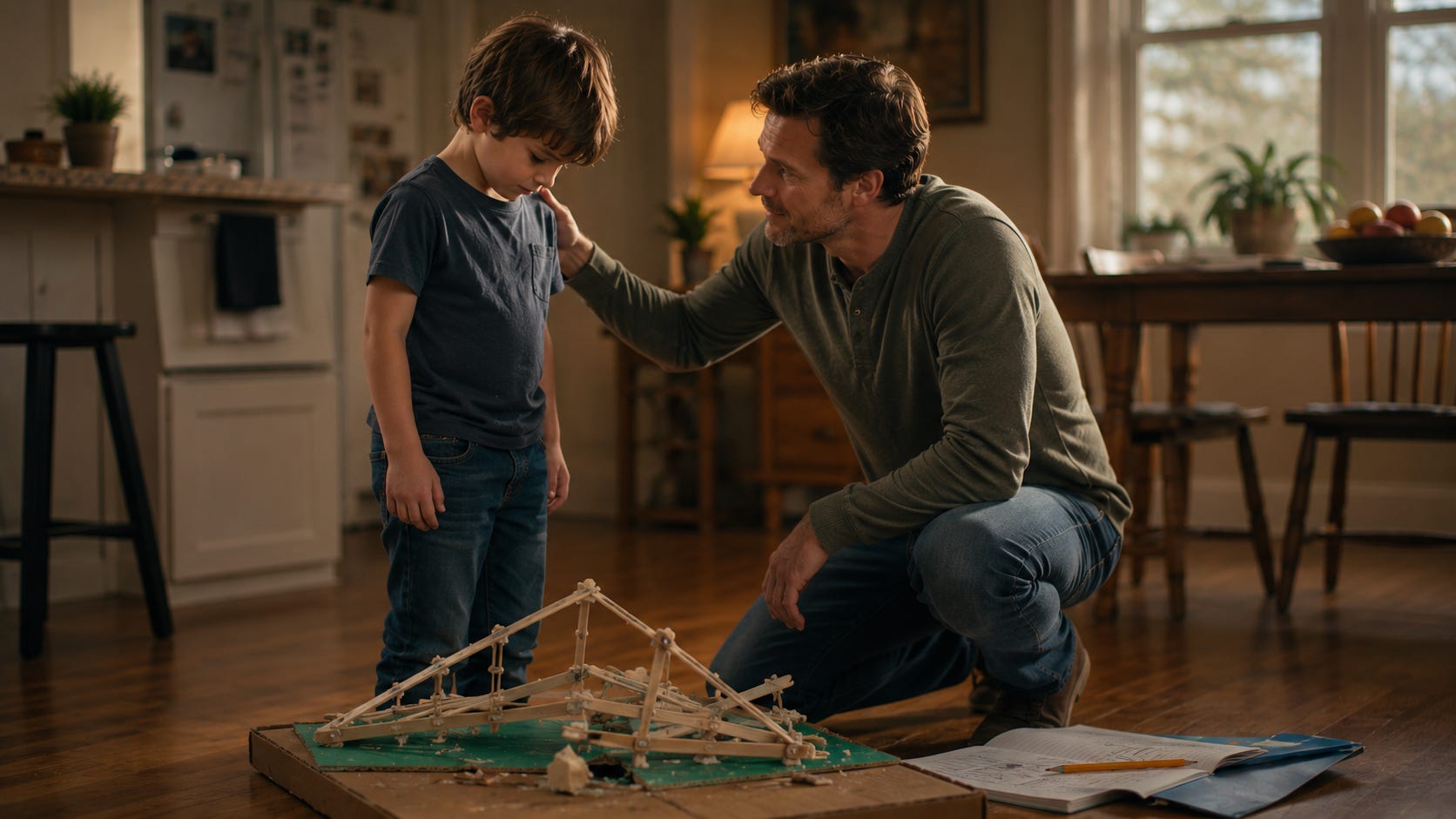
For anyone raising kids now, I find myself wondering what it might look like to pay closer attention to those ordinary moments, on purpose, since they may be teaching something quieter and more lasting than anything said from a pulpit.
I don’t know the full answer. But with four kids now grown, and these conversations still unfolding, I think that question matters more than most of the advice I could give about it.
© Dr. Doug Gulbrandsen