

A fish does not know it is swimming in water. The water is simply there, so familiar that it never occurs to the fish to question it. We grow up the same way, surrounded by ideas about what makes a person valuable, what a successful life looks like, and what we ought to want. These ideas are so woven into the world we know that they stop feeling like ideas. They feel like reality.
I believe this is one of the quietest ways we lose touch with ourselves. It happens gradually, through the acceptance of a life someone else taught us to want, and it rarely feels like a loss while it is happening.
What nobody had to teach us
Most of our deepest beliefs never arrived as choices. We learned what a respectable career looked like by watching who received admiration. We learned which emotions were acceptable by noticing which ones made the adults around us uncomfortable. Nobody sat us down and explained the rules. We absorbed them the way a child picks up an accent, through repetition, approval, and the desire to belong.
A child in a family that prizes achievement may learn that being productive is the surest way to be noticed. Another grows up where sacrifice is the highest form of love and later finds it hard to name their own needs without feeling selfish. Someone raised in a religious community may learn that certainty is evidence of faith and that questioning is weakness. In each case the lesson is so much a part of ordinary life that it becomes hard to tell what was learned from what is true.
None of this requires bad intentions. Parents teach what they believe will help their children survive. Communities protect traditions that gave people meaning and stability. Cultures hand down their accumulated wisdom, and they hand down their fears with it. We inherit both, usually without knowing which is which.
When familiar becomes true
Hear something often enough from people you trust and it begins to feel self-evident. At that point we stop asking whether the idea is accurate and start measuring ourselves against it.
Take the belief that a meaningful life must be a productive one. There is real truth in it. Work matters, contribution matters, and there is genuine satisfaction in putting our abilities to good use. The trouble starts when contribution quietly becomes the measure of worth. Rest begins to feel uncomfortable, and an unproductive afternoon carries a faint sense of guilt.
Retirement is often where this shows itself. A person who spent forty years being recognized for what they do loses the title, the responsibilities, and the daily affirmation that made their identity feel secure. Nothing essential about them has gone anywhere. Their capacity for love, curiosity, and kindness is fully intact. Yet the absence of a role can feel like the absence of a self. What retirement exposes is where they were taught to keep their value all along, somewhere outside themselves.
The same pattern runs through money, appearance, and social standing. We pursue something for years because everyone seems to agree it matters, finally reach it, and find the satisfaction surprisingly brief. Then the next standard appears.
And we keep swimming.
The quiet conditions of belonging
These assumptions are hard to question for a very human reason. Belonging comes with conditions, and most of them stay invisible until someone steps outside them.
A young adult chooses an unconventional career and discovers how much of the family’s approval depended on a particular path. A woman begins setting boundaries and finds that the people who praised her generosity are less comfortable with her honesty. A man admits he is struggling and senses the unease of everyone who has always known him as the strong one. These are the moments when the water becomes visible.
Questioning an inherited expectation can feel like questioning the people who gave it to us, so we stay loyal to beliefs that no longer fit. Much of that loyalty comes from never having separated gratitude for what we received from obedience to everything that came with it. Those are two different things. We can love the people who raised us without repeating every pattern they lived, and we can honor a tradition while examining the assumptions that have gathered around it.
Seeing through another window
Living in Thailand after most of my life in the United States has made some of my own water easier to see. Here I see people living on about five hundred dollars a month, and they are happy. They greet you with smiles. By the standards I grew up with, that should not work. The pace of life, the place of family, and the way people show respect have all asked me to reconsider things I had long assumed were simply how life works.
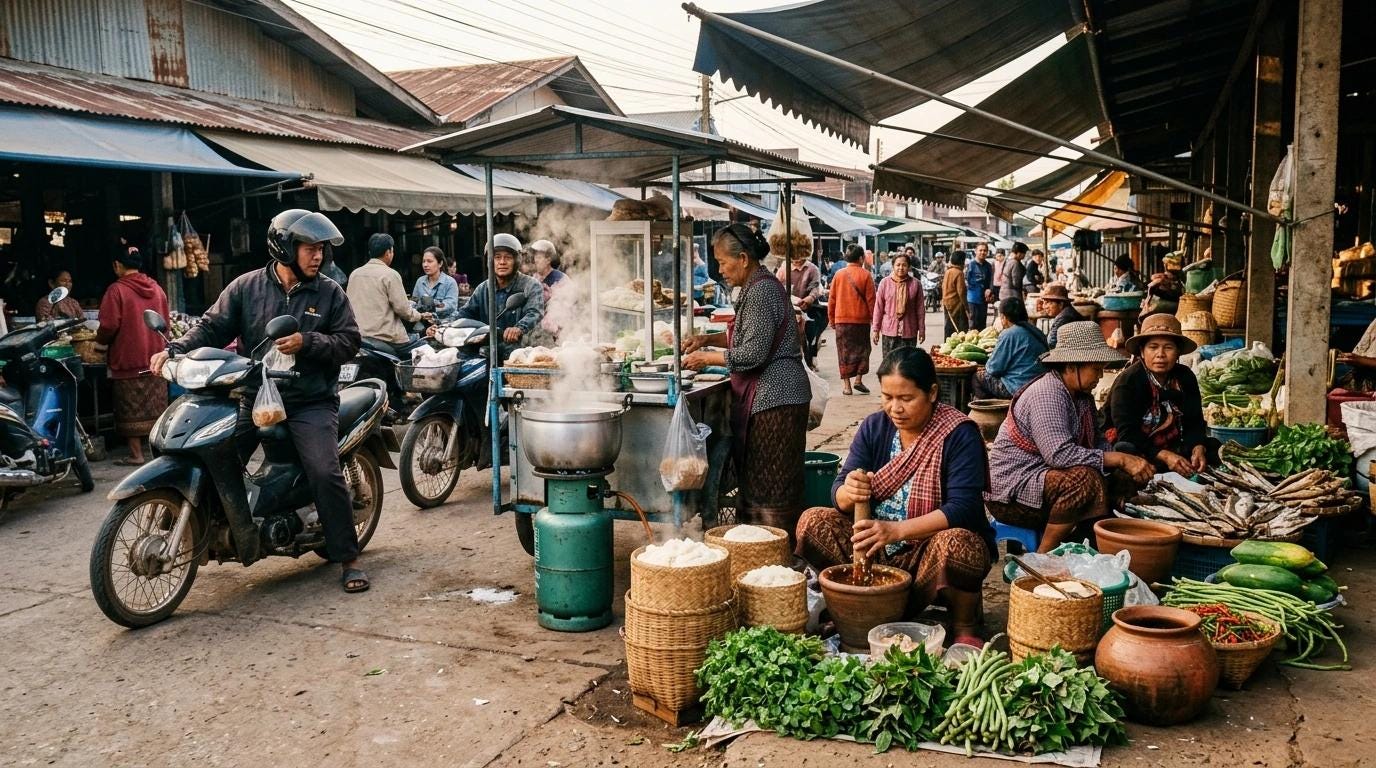
Thailand has its own contradictions and blind spots, as every culture does, and its own water that people here rarely notice. What changed for me was simpler than deciding one place had the answers. I realized that the way I had been taught to live was never the only possibility.
If people can organize their lives around very different assumptions and still find meaning, connection, and joy, then some of the rules I followed were never universal truths. They were familiar arrangements, handed down until nobody remembered that another arrangement was possible. I found that surprisingly freeing.
Once we start noticing our conditioning, there is a temptation to throw all of it out. But that is just one more belief we have not examined. Much of what we inherited has served us well: generosity, perseverance, respect for others, a deep sense of family. None of it needs to be abandoned because it came from our upbringing.
The more useful question is whether we are living from understanding or from automatic agreement. Generosity is a good example. A person can give because it expresses something they value, or because they are afraid someone will stop loving them if they say no. From the outside the two look identical. Only the person giving knows whether it comes from freedom or from fear, and the same is true of achievement, service, faith, and marriage.
This is not always comfortable work. Some beliefs have protected us from uncertainty for years, and others have given us a place among people we love. Questioning them can bring up guilt and confusion. In my experience that discomfort does not mean we are going the wrong way. Often it is simply what an old certainty feels like as it makes room for something more honest.
A quieter freedom
We usually think of freedom as the ability to do what we want. There is an earlier freedom, and it is knowing where our wants came from.
Am I working this hard because the work matters to me, or because I feel anxious when I am not producing something?
That question does not need an answer today. Rushing toward one may be the conditioning at work again, since most of us were trained to identify a problem, solve it quickly, and move on. What I have found more useful is simple noticing. I have started catching the moments when I hear myself say “That’s just how things are,” or “People like us don’t do that,” or “I should be further along by now.” Those sentences usually carry fingerprints from long before I was able to evaluate them.
Whose voice does that sound like? I find that worth sitting with before trying to change anything.
None of this is a self-improvement project. We are social beings, shaped by relationships and history, and much of that shaping is good. Nobody becomes a perfectly independent thinker, and that was never the point. The invitation is only to become a little more conscious of what has been shaping us.
The water is still there
Seeing the water does not lift us out of it. We live among the same people, speak the same language, and keep many of the same traditions. From the outside, life may look almost unchanged.
The change is in where we stand. We may still work hard without believing our worth depends on it. We may keep family traditions while choosing which ones still reflect our values. We may stay in the same community and be less afraid of asking honest questions.
It changes how we see other people too. Once I recognized how much of my own outlook came from circumstances I did not choose, it became harder to judge others for theirs. They are swimming in water of their own, and it is no more visible to them than mine was to me. Curiosity has a way of moving into the space where certainty used to be.
I invite you to consider where, in your own life, the world you have always known might be less fixed than it has seemed.
© Dr. Doug Gulbrandsen