

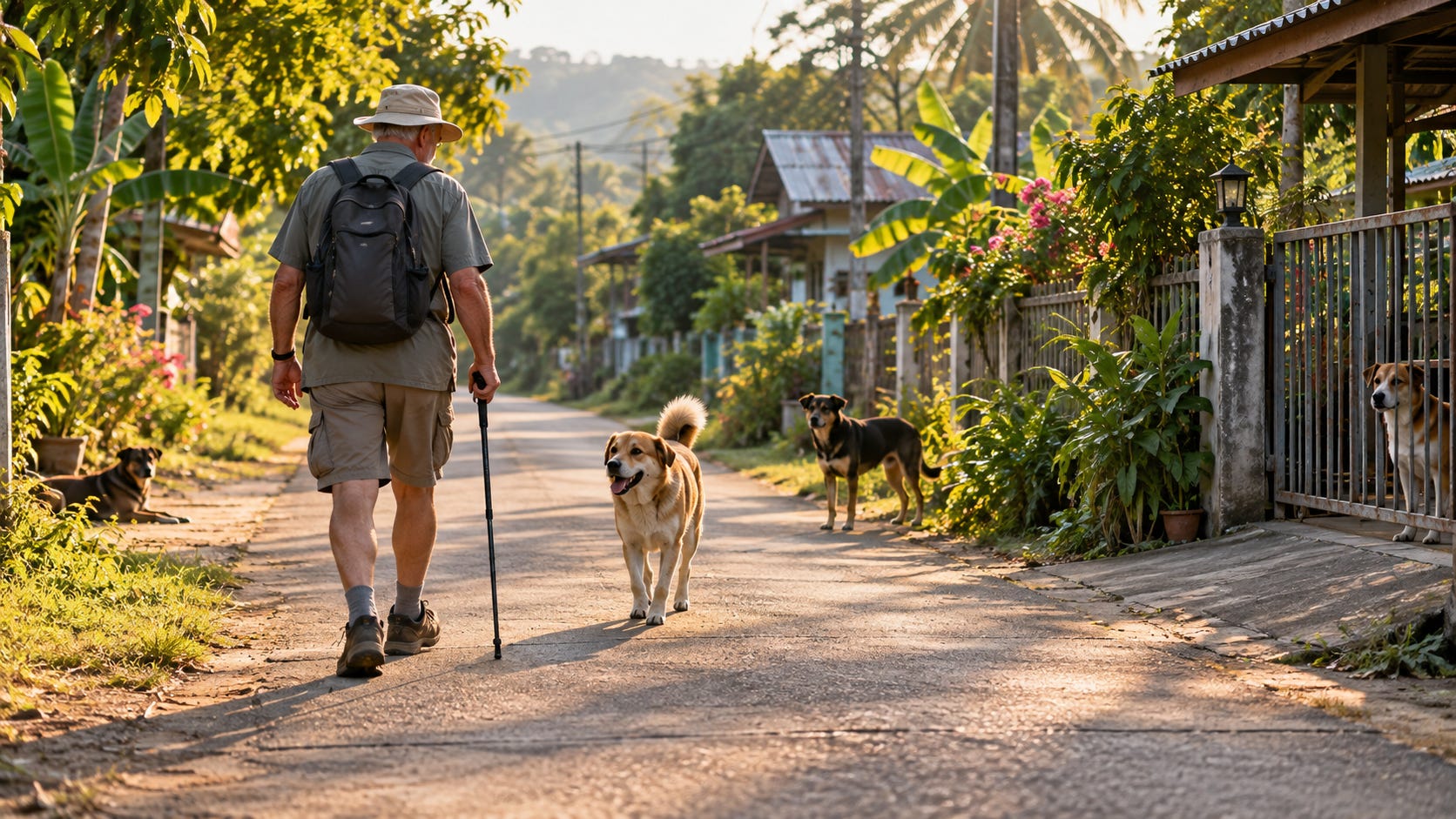
Most mornings when I walk here in Thailand, I encounter dogs. Some are resting along the roadside, others wander through the neighborhood or watch from behind closed gates, and a few seem to consider it their responsibility to announce my arrival.
Over time, I’ve noticed something interesting. Although I’m the same person walking along the same road, the dogs respond to me in remarkably different ways.
Some see me coming and immediately begin wagging their tails. They approach with what almost looks like a grin. There is no apparent hesitation, no need to determine whether I belong there. They’re simply glad someone came by.
Others begin much the same way. Their tails wag, and they take a few tentative steps toward me. But somewhere between curiosity and contact, something changes. They stop, reconsider, and retreat. Sometimes they run away altogether.
Then there are the barkers. Some do it from behind a gate, which makes them considerably braver. Others come toward me barking, making quite a commotion, as though they have something important to say about my presence. Yet if I turn toward them or take a step in their direction, they quickly retreat. The barking continues, but now from somewhere they consider safe.
A few are more aggressive. They come toward me barking, sometimes with enough determination that I stop walking. When I turn to face them and hold out my hiking stick, they usually stop or move away. And on one occasion, a dog actually came close enough to nip my leg.
I’ve thought about these encounters quite a bit, not because I understand the minds of dogs, but because I recognize something familiar in their behavior.
I see us.
The Same World, Different Experiences
I’m not approaching one dog with kindness and another with hostility. I’m simply walking. Yet each dog responds differently. One sees an opportunity for connection. Another seems interested but uncertain. A third acts as though my presence requires a warning. And another responds as though it must defend itself.
Their behavior may reflect temperament, territory, past experiences, or something happening in that particular moment. We cannot know for certain. But the differences invite a question worth considering.
How much of our own response to life comes from what is actually happening, and how much comes from what we have learned to expect?
Four people can enter the same room and have four entirely different experiences. One feels comfortable and begins a conversation. Another wonders whether anyone wants them there. Someone else quietly observes, reluctant to expose too much of themselves. And another enters already prepared to defend an opinion no one has challenged. The room is identical for all four of them, and each one walks in carrying something the others cannot see.

When We Want to Come Closer
I find myself particularly drawn to the dogs that begin to approach, tails wagging, only to turn and run away. There is something contradictory in their behavior, a movement toward connection followed by a sudden retreat. I wonder how often we do the same.
We want to be known, but hesitate when someone begins to know us. We long for meaningful relationships, yet become uncomfortable when they require vulnerability. And new possibilities are welcome right up until they begin to challenge what feels familiar.
Sometimes we interpret that hesitation as a personal weakness. We tell ourselves we need more confidence, more courage, or greater determination. In my experience, hesitation is often something we learned at a time when caution served us well.
A person who has experienced rejection may approach a new friendship with both hope and apprehension. Someone who has been criticized repeatedly may become uncomfortable receiving attention, even when that attention is kind. The desire to connect is still there. So is the memory of what connection once cost.
The Ones Who Bark
Then there are those dogs that make the greatest amount of noise while maintaining the safest distance. They remind me of another familiar human response.
Some people become loud when they feel uncertain. They criticize, challenge, interrupt, or insist on being right. Their words may sound confident, even intimidating. Yet beneath that outward certainty, there may be a person who feels threatened by disagreement, difference, or the possibility of being wrong.
Not every strong opinion comes from fear, of course. Sometimes a firm voice is simply a firm voice. But there are moments when our defensiveness tells us more about what is happening within us than about the person standing before us.
I have noticed this in myself over the years. There have been times when I felt the need to explain, justify, or defend something before anyone had actually questioned it. Looking back, I can see that I wasn’t always responding to the conversation taking place. Sometimes I was responding to an older conversation, one that had ended years before but continued quietly within me.
We can spend a surprising amount of our lives barking at things that are no longer pursuing us.
When Fear Becomes Aggression
The dog that nipped my leg offered a different reminder. It hurt. For a while afterward I avoided that part of the road, and when I did walk it, I made sure I was ready in case the dog came out again. One nip, and I had learned to expect it.
Not every fearful or defensive response remains at a distance. Sometimes it moves toward the very thing it perceives as threatening. Human beings can do this too. We may attack someone’s character when we feel our own identity being questioned. We may become controlling when we fear losing a relationship. We may respond with anger when the feeling underneath is embarrassment, insecurity, or hurt.
This doesn’t excuse harmful behavior. A bite is still a bite, and its consequences are real. Understanding what may be behind a response does not mean we should accept being harmed by it.
That is something my hiking stick has helped me remember. When an aggressive dog approaches, I don’t need to become aggressive in return. But neither do I need to pretend there is no danger. I can stop, turn, establish some distance, and protect myself.
Firmness is not the same as fear, and I have come to think the difference matters as much in a relationship as it does on a road full of dogs. We can understand someone’s pain without allowing that pain to become our responsibility to endure.
The Freedom to Wag Our Tails
Of all these encounters, I keep returning to the dogs that greet me with such uncomplicated delight. They see someone approaching, and their first response is curiosity, openness, and what appears to be simple happiness.
I don’t imagine they have solved all the problems of being a dog. Nor do I assume their friendliness means they have never known difficulty. But in that moment, they seem free to meet what is in front of them without first defending themselves against what might happen. There is something appealing about that.
I wonder what it would mean for us to experience more of life that way. I don’t mean becoming naive, or ignoring the wisdom that difficult experiences have given us. I mean recognizing when an old protective response is no longer necessary. It might be the moment we begin to withdraw from someone who has offered us nothing but kindness, or the moment our need to be right grows stronger than our willingness to understand. Often the body knows first. Something tightens before it turns into words we later regret.
And perhaps, occasionally, we can ask ourselves a simple question:
Am I responding to what is happening now, or to something I learned to fear long ago?
That question alone may create a little space. And sometimes a little space is all we need to discover that we have a choice.
A Different Way of Walking
I still encounter the same variety of dogs on my walks. Some welcome me. Some hesitate. Some bark from a distance. And others remind me to keep my hiking stick close.
I don’t expect them all to change. But I find myself wondering how often I have moved through life in each of those ways.
How many opportunities for connection have I approached with enthusiasm, only to retreat when they became too real?
How often have I made unnecessary noise because something within me felt uncertain?
And how many times have I defended myself against a threat that existed more clearly in my memory than in the moment before me?
I suspect most of us have been every one of those dogs at different times in our lives.
What I have found is that emotional growth has little to do with eliminating fear, caution, or the instinct to protect ourselves. Those responses have their place. It has much more to do with becoming aware enough to know when they are needed, and when they are simply familiar.
We don’t have to greet every stranger with open arms. We don’t have to approach every experience with unquestioning trust. But we might learn to meet more of life without assuming it has come to hurt us.
And on those occasions when the world offers nothing more threatening than a friendly face and a passing hello, perhaps we can allow ourselves the simple pleasure of wagging our tails, not because life has become perfectly safe, but because we have become a little freer to meet it as it is.
© Dr. Doug Gulbrandsen