


Section One: Naming What We Carry
Grief is not limited to the death of a loved one. Any loss qualifies. A relationship that ends. A career that changes. A dream that quietly dissolves. A childhood that contained things it should not have, or lacked things it should have had. A body that can no longer do what it once did. A future you had imagined in some detail that will not arrive. Every one of those losses carries grief with it, whether we name it that or not.
Most of us were never given that broad a definition. The story we received was much simpler. Someone dies. You experience a deep loss. Life continues. And somewhere in the continuing of it, we learn to fold the grief inward, carrying it in a way that stops drawing attention. Well-meaning people remind us that time heals, that life goes on, and we do what is required to satisfy that expectation. What we do not do, most of the time, is actually grieve.
The other losses tend to arrive without a name. A relationship ends and we tell ourselves we are fine, or that we should be. A career changes and we call it an adjustment. A childhood that left gaps may not register as loss at all until years later, when something surfaces that we cannot quite explain. The grief was real even when no one, including ourselves, had a frame wide enough to recognize it.
And this matters. A large number of people are walking around exhausted, emotionally flat, unable to sleep, unable to feel genuinely present in their own lives. They are grieving something they have not yet named.
That question opens something worth thinking about. What if the fatigue many of us carry is not simply stress or busyness, but accumulated, unaddressed grief that has had nowhere to go?
I think it is worth considering that emotional fatigue tends to arrive first. Small things begin to pile up. A missed deadline. A forgotten obligation. A moment where you were not quite enough for yourself, A moment where you fell short of your own impossible standard, and the quiet shame that follows it. One by one these things accumulate, and what started as a manageable weight becomes something much heavier. Then, when someone reaches for their spiritual life as a counterweight, they often find it either absent or distant. And feeling spiritually disconnected on top of emotionally exhausted has a compounding effect. People describe it not as a single problem but as carrying an entire steamer trunk around all day. They wake up tired. They go to bed tired. They are tired the entire time in between.
The interesting thing is that most of them do not know what is in the trunk.
There is a phrase I have returned to more than once over the years. That which we resist persists. It is not original to me, but it holds up every time I press on it. The harder we push against something, the more stubbornly it remains. And grief, specifically, seems to behave this way. We learn very early to manage it, to perform our way past it, to keep going. We are culturally trained to expect problems to resolve quickly. There is an entire architecture in modern life designed around the assumption that if we apply the right method with enough focus, things will change fast. The 30-minute resolution. The rapid-result framework. The personal transformation system.
But whatever we are carrying did not arrive overnight. It will not leave overnight.
What I find worth considering is this: walking with grief is different from either wallowing in it or fighting it. Walking with it means allowing it to be present, without making it the object of constant forceful effort. There is a kind of quiet willingness required here. The willingness to stop, look at what is actually there, and let it be real. To honor it for what it is. Something closer to patient honesty than passive resignation.
The person who slows down enough to genuinely ask what they are actually carrying has taken the step that most people skip. The more common move is to notice something is wrong and then continue past it, to keep functioning, to stay busy, to let the moment close without looking at what was in it.
Naming it turns out to be significant. Not a ritual or a checklist. Simply being specific about what was actually lost.
If someone grew up in a home where a parent was absent, not through death but through preoccupation, illness, ambition, or circumstance, there are real things they missed. What would fishing trips have taught? What would road trips have built? What would simply being seen by a parent have settled inside a child? Those are not abstract losses. They are specific, and they carry weight, and until someone sits down and actually names what was taken or withheld, the grief stays compressed and unprocessed somewhere below the surface. Feelings that are buried do not disappear. They tend to resurface as other things: physical symptoms, relational patterns, a low-grade sense of wrongness that never quite resolves.
One way the naming can happen is through writing. Not a polished account. Not an orderly record. Something more like emptying the mind onto a page, a full brain dump, messy and ungoverned, until what was circling around internally becomes visible externally. There is something in the physical act of writing, the connection from thought down through the arm to the page, that the screen does not quite replicate. Once it is visible, you can begin to work with it. Pick one thing. Just one. Notice what it is. Ask whether it is serving you, or whether it has simply been following you around.
Another tool is the letter. Written to someone you may never send it to. A parent who is gone. A person who caused harm. A younger version of yourself. The point is not the sending. It is the articulation. Writing what was missed. Naming the impact. Extending forgiveness where it is ready to be extended, not because forgiveness resolves the grief but because carrying resentment on top of grief is an additional weight most people cannot afford. Reading that letter aloud to a trusted person, someone who can simply listen without fixing or interpreting, has a quality to it that silent writing alone does not. There is something about saying it into the world, out loud, in front of another person, that completes a circuit.
Grief and gratitude are not opposites. This is where I want to be careful, because the suggestion that gratitude can accompany grief is easy to misuse. It can become a way of skipping past the grief entirely, a spiritual bypass dressed in thankful language. Gratitude, when it arrives honestly, can exist alongside loss without canceling it. Someone can grieve a childhood that was incomplete and also be genuinely grateful that what was missing became, over time, a motivation to show up differently. For their own children. For the people around them. For themselves. Both things can be true at the same time. The grief does not have to be resolved for the gratitude to be real. They can travel together.
This requires presence rather than performance. Performance is our cultural default. We are oriented toward doing, producing, fixing, demonstrating competence. Presence is quieter. It simply asks: what is actually happening here, and can I be in it rather than immediately beyond it?
There is also this to notice: perfectionism is frequently grief in disguise. People who strive relentlessly toward an impossible standard are often trying to control an outcome because something once went very wrong and they have decided, below the level of conscious thought, that if they are meticulous enough, that wrong thing will never repeat itself. The control is the response to the wound. The perfectionism is the armor. And no amount of performance will reach the standard it is aimed at, because the standard is not really about excellence. It is about safety. About not being hurt again.
What gets underneath that is grief work, not a more disciplined system or a better framework. It means finding what was actually lost, naming it, allowing it to matter, and slowly releasing the armor that was built to protect against it.
Consider where any of this might be sitting in your own experience. What in your life has changed, ended, or been withheld that has not yet been named?
But naming the weight is only the beginning. The question remains: once we know what we are carrying, how do we actually move? In the next section, we look at the ladder of emotional movement and why ‘feeling worse’ is often the first sign of getting better.
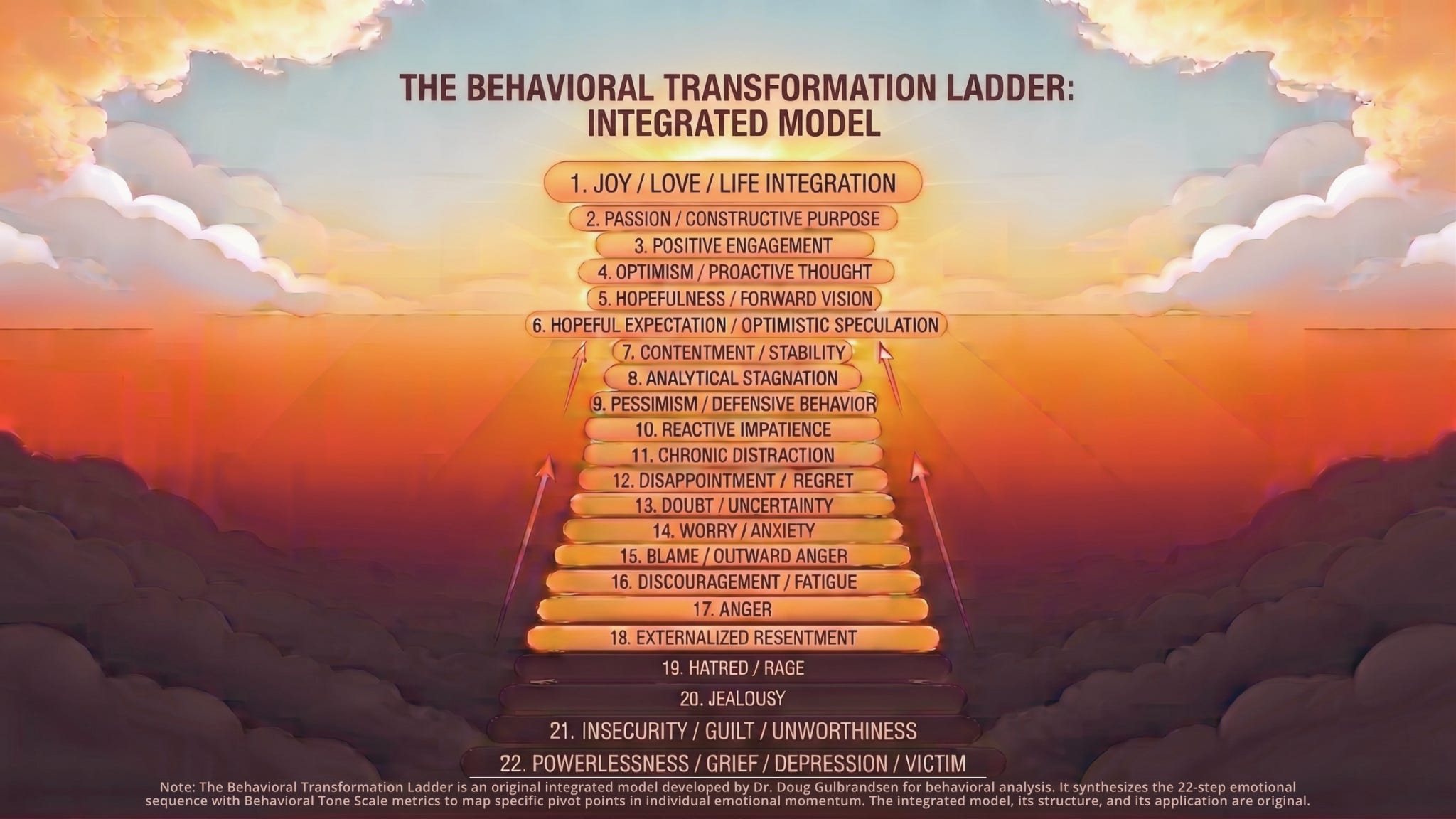
Section Two: The Upward Climb of Disappointment.
What Movement Actually Looks Like
This model grew out of my research into existing emotional guidance and tone scales, including work by others who have mapped emotional hierarchies in similar ways. The synthesis and the specific structure are my own. It maps twenty-two emotional states from grief, depression and powerlessness at the bottom to joy, love and complete life integration at the top.
I have been working with this model for some time now, and the part I keep returning to in the context of grief is the middle of the ladder.
As someone begins to acknowledge grief and move up from that lowest rung, the emotions that tend to arrive first are not dramatic. More often they are quieter ones. Disappointment. Regret. A kind of heaviness that says: I am sad this happened, and I wish things had gone differently. These can feel like more of the same grief, or like a deeper settling into loss. A person working through something difficult who finds themselves sitting with disappointment and regret might reasonably assume they have not made much progress.
Notice that disappointment and regret sit at rung 12 on this scale,more than halfway up from the frozen powerlessness at the bottom. The movement from feeling nothing, from the numbness and flatness of deep unacknowledged grief, to feeling genuinely disappointed about what was lost is not a step sideways. It is a significant climb. The discomfort of those middle states is evidence of movement, not evidence that something has gone wrong.
I find that worth focusing on, because it runs against the assumption most of us carry into any kind of inner work: that healing should feel consistently better at every step. In my observation, it often does not work that way. The discomfort of moving up through those middle states feels remarkably similar to the discomfort of staying stuck in that state. Sitting with it long enough to ask which one it is. That is the actual work.
What would it mean to notice disappointment or regret arriving, and receive that as information about where you are on the ladder rather than a verdict on whether you are making progress?
The rungs above the middle are worth knowing as well. Contentment and stability. Hopefulness. Optimism. Enthusiasm. Passion. They are not states to perform or manufacture. They are destinations that become available as the lower weight is slowly released. The aspiration of joy and complete integration at the top sits above grief on the scale, arrived at by moving through the full range of what it means to be human, not by bypassing any of it.
There is a more clinical way to describe what staying at the bottom of that ladder actually does to a person, and I find it worth understanding.
Stephen Porges, a neuroscientist whose work on the autonomic nervous system has significantly shaped how trauma is understood, identified what he called the dorsal vagal response. It is the nervous system’s deepest protective state, characterized by shutdown, numbness, and functional freeze. Grief that has not been named or witnessed, that has simply been carried without acknowledgment, tends to settle into exactly that state. The body is doing something more specific than being sad. It is conserving itself against something it does not know how to move through.
I want to be careful here, because I am not a neuroscientist and the field is more complex than any brief description can hold. But the functional consequence is something most people can recognize even without the technical language. A person carrying unacknowledged grief at the bottom of the ladder tends to experience everything through it. A neutral comment from a colleague reads as rejection. A minor change in plans feels like loss. The grief becomes the frequency through which every experience passes, not because the person is irrational, but because the unprocessed loss is the most active thing in their emotional life. It colors everything above it.
This is what the emotional intelligence literature describes as a narrowing of emotional range. Emotional intelligence, at its core, requires what you might call a full palette, the capacity to perceive and move through the whole spectrum of emotional experience. When a significant portion of that capacity is absorbed by something unnamed at the bottom, the palette shrinks. The clinical literature refers to this as affective foreclosure, in which emotional development essentially stops at the point of the unaddressed loss. The person keeps arriving at the same place, interpreting different situations through the same lens, because the thing that needed acknowledgment has not yet received it.
A person who bypasses unacknowledged grief and reaches for optimism above it has constructed something on an unstable floor. What tends to follow is a brittle emotional state that collapses under any real pressure, precisely because nothing beneath it has shifted. This is what makes the work of walking with grief something more than poetic encouragement. It is a functional requirement for emotional movement.
Here is what I find most compelling about the ladder in this context. Moving from the bottom of the scale to disappointment and regret, which can feel like settling more deeply into sadness, actually represents something specific in emotional terms. At rung 22, grief carries powerlessness with it. The person is simply submerged. Disappointment and regret carry something different: a quiet acknowledgment that what was lost actually mattered, and that things could have gone another way. That acknowledgment is itself a form of agency. The person who can name what they are disappointed about has moved from frozen powerlessness to something that has a direction, a claim, a voice. That movement, even when it is gentle and quiet, is the actual beginning of emotional recovery. Acknowledging the grief is what makes it possible. Without the acknowledgment, the functional freeze tends to hold.
There is something worth examining directly: the idea that the goal of grief work is to resolve grief. To finish it. To move through it until it is no longer there.
I am not sure that is true, or that it is even the right aim.
Grief is part of life. It arrives with love, with change, with the fact of being a person who experiences things that matter. The aim, as best I can see it, is relationship with grief rather than resolution of it. We can observe what grief is when it comes. We can honor it, sit with it long enough to recognize what it is pointing to, what it carries, what it is asking of us. We can walk with it patiently rather than forcing it to move faster than it moves.
What I have observed, and what those who work closely with grief tend to notice, is that this willingness changes something. When grief is no longer being pushed away or managed from a distance, it tends to revive itself less often. Its presence becomes less consuming. Not because it has been eliminated, but because it has been seen. It no longer has to compete for attention.
A trigger will still arrive. A particular date. A song. A smell. Something catches you off guard, and what you thought had settled surfaces again. The question, when that happens, is simply whether you can observe what is there, honor it for what it is, and let it pass through rather than push it back down to where it started.
That, I think, is what walking with grief actually looks like across a lifetime. The terrain becomes familiar. When something pulls you down a rung or two, you know where you are. You can name it, find your footing, and step back up and perhaps beyond.
None of this moves quickly. That, I think, is one of the most honest things that can be said about grief. Whatever is sitting inside of it accumulated over time, and it asks for time in return. The temptation is to treat it like a project, to apply maximum effort and then be finished. But grief does not respond well to force. It responds to patience. To the willingness to observe one thing at a time. To the understanding that as we walk with it honestly, something settles. Not because the grief has left, but because we have stopped fighting it. That settling is the evidence that something is shifting.
What might it mean to walk alongside what you are carrying, rather than either collapsing under it or fighting it? To name it. To honor it. To let it be real without demanding that it leave.
© 2026 Doug Gulbrandsen. All rights reserved.