

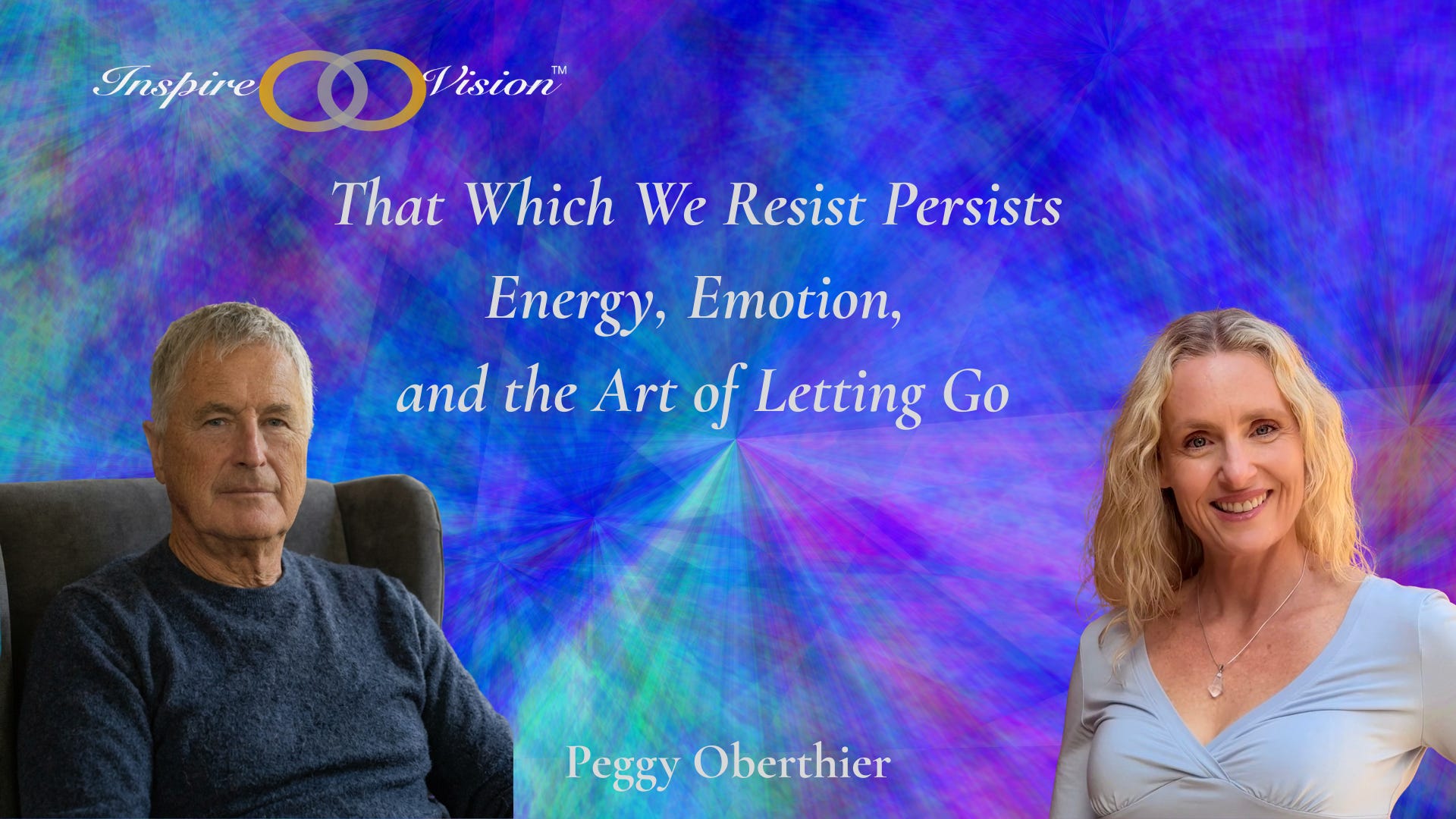
I spoke recently on my podcast with Peggy Oberthier, an Australian medical intuitive and mentor, whose work centers on the relationship between emotional experience and physical health. She brought an idea into the conversation that I keep coming back to.

What if we have been listening to ourselves in only one language, while our lives have been speaking in several?
Most of us were trained early to trust the analytical mind. We gather facts, solve problems, explain our experiences through logic and reason. Those are real capacities, and I do not want to diminish them. But human beings have also always sensed another kind of knowing, something quieter, harder to name, and frequently ignored.
A mother wakes moments before her child cries. A person feels uneasy before a decision that later proves costly. A quiet impression nudges someone toward a conversation they had not planned to have. What is that? I find it worth considering rather than explaining away.
The older I become, the more I notice that wisdom tends to arrive softly. Not in arguments. Not in the conclusions I worked hard to reach. In the things that were simply there when I got quiet enough to hear them.
One idea from this conversation has stayed with me more than the others. Peggy suggested that the body often carries what the mind never fully processed, that emotions which had no safe place to land do not disappear. They go somewhere.
I think most of us recognize this, even if we have not named it that way. Many of us learned early that certain feelings were not acceptable. Anger had to be managed. Grief had to be moved through quickly. Fear looked like weakness. Sadness made people uncomfortable. So we learned to keep the surface smooth. We performed being fine, sometimes for so long that we forgot we were performing.
What stays with me is not a dramatic claim about energy or illness. It is the simpler observation that unresolved stress leaves marks. Modern research on chronic stress, inflammation, and nervous system function supports this, though the specifics are still being worked out. What is harder to dispute is the lived experience: that the body sometimes registers things the conscious mind has chosen to step around.
And here is something I keep contemplating. Sometimes naming an emotion honestly, not explaining it, not resolving it, just naming it, is itself a form of relief. To say quietly, “I feel disappointed,” and mean it without immediately trying to fix or justify it, is not weakness. It is a kind of accuracy. Accuracy, in my experience, tends to be where peace begins.
There is a related question worth sitting with. Many of us grew up, without fully realizing it, believing that love had to be earned. We were praised for achievement, rewarded for performance, accepted when we met expectations. Over time the distinction between what we do and who we are can get very thin.
When things shift, a career ends, children leave, health changes, something can surface that feels like a question rather than a crisis. Not “what do I do now?” but “do I still matter?”
What I have found is that this question almost always contains a wrong assumption. Worth was never the thing you were building. It was always what you were standing on. The traditions I have studied, Christian, Buddhist, Jewish, say something similar here, though they say it differently and for different reasons. The image of God in Jewish and Christian thought is not something achieved. Buddha nature in the Theravada tradition is not something constructed. The specifics matter, and they do not reduce to the same claim. But the direction each points toward is the same one: the deepest thing about you is not something you manufactured.
Silence turns out to be useful for exactly this reason. Not because it gives new information. Because it removes the noise that makes it difficult to hear what was already there.
I do not believe every ache has a spiritual explanation. Life is more complicated than simple formulas, and I want to be careful here. I am not a clinician, and I am not suggesting that emotional work replaces medical care. But I do believe that healing often involves more than treating symptoms. Something in us has always known this, even when we could not quite say what it was.
Perhaps intuition is not a mystical gift. Perhaps it is the quiet that remains when we stop arguing with ourselves long enough to actually listen.
That may be the most practical thing Peggy said. And I have been thinking about it ever since.
I invite you to ponder where in your own life you might have stopped listening to one of the languages you speak.
For the full podcast, go to
© Dr. Doug Gulbrandsen