

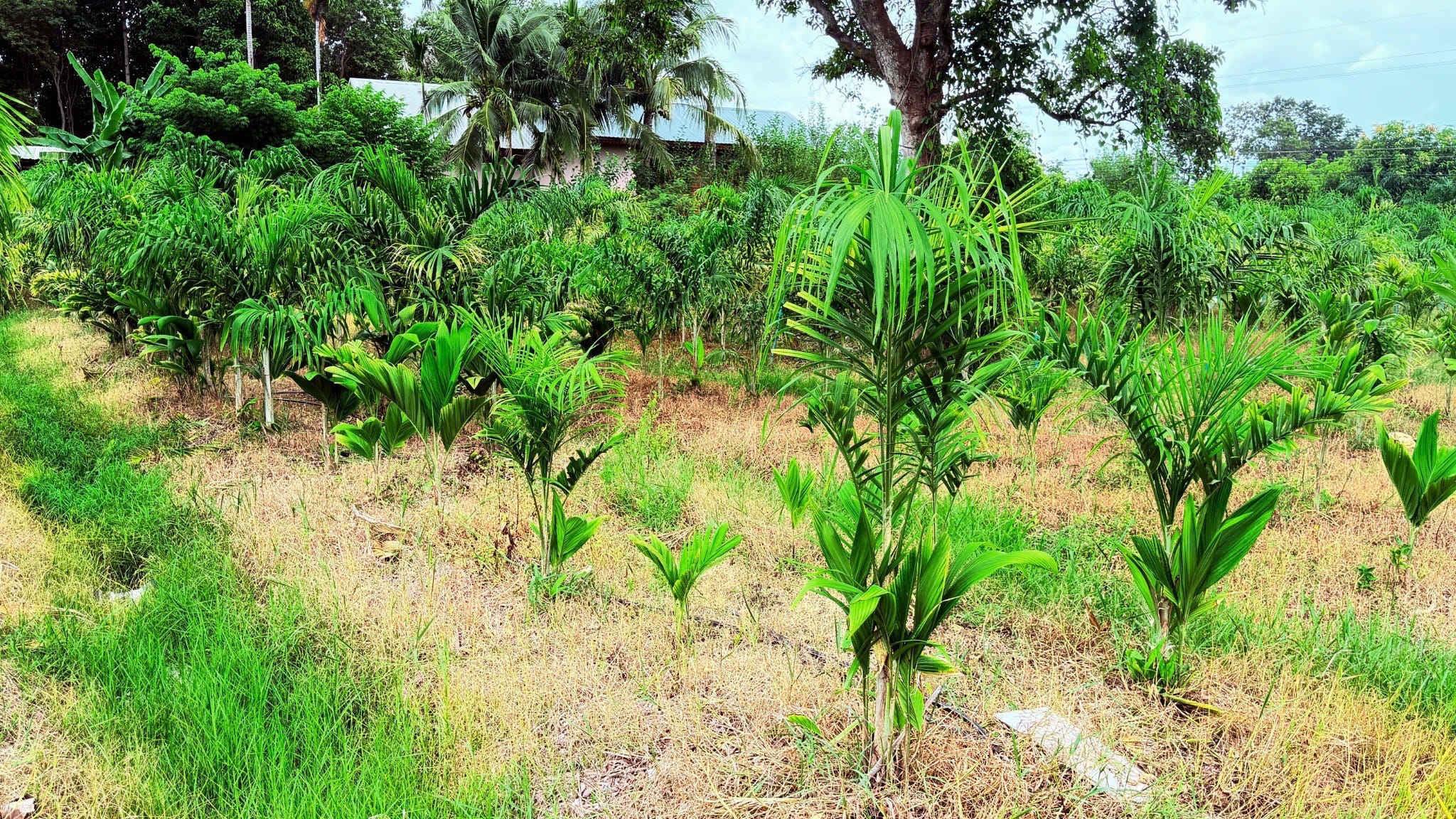
A year and a half ago, we planted peach palm trees on our farm here in Thailand. Every tree went into the same soil the same season. They drink from the same water lines and have received the same care from the day they were planted. And yet some of them have grown tall and full, while others, planted the same week, are still small. I have walked the rows looking for the explanation. The water lines reach everyone. I checked.
Whatever accounts for the difference is happening somewhere I cannot see. In the seed. In the roots. In some quiet condition underground that nobody measured. Everything visible was identical, which means the answer was never going to be visible. That caught my attention, and it has stayed with me since.
This is where it gets interesting to me personally. Years ago, while studying for a certification in a behavioral assessment, I came across a case study about two men hired by the same company. Both had interviewed well. Both went into sales. One became remarkably successful, and the other struggled, and nobody could explain why, because on paper they were the same. When the company finally looked beneath the surface, the assessment showed that one man carried a strong economic motivation, and sales fed that motivation every single day. The other man’s deepest pull was toward artistic expression, and economics barely registered in him at all. Sales gave the thing that moved him nowhere to go.
I want to be clear about what that story does not mean, because it would be easy to read it wrong. It does not mean one man had the right wiring and the other had the wrong wiring. Neither motivation is better. The second man was not failing so much as dimming, spending his days in work that fed nothing he actually carried. The company saw an underperformer. What was actually standing there was a man planted in soil that had no conversation with his seed.
In the personal portraits I create, I call this layer the inner spark. It is the current of motivation underneath everything else, the thing that pulls at you when no one is telling you what to do. When that current is engaged, life feels meaningful rather than merely functional. When it goes unengaged for long enough, the effect is rarely dramatic. It is more like a quieting. A gradual loss of energy for things that should matter. The slow sense that you are going through the motions of a life that is not quite yours. I have seen this in work, and I have seen it in relationships. The circumstances are not always wrong in any obvious way. They are simply not in conversation with what the person carries inside.
There is a word I have built much of my thinking around: congruent. In my experience, when a life is congruent with those inner sparks, when the outward circumstances and the inward current are actually speaking to each other, joy stops being something you chase and becomes something you notice. Love, value, peace. These are not rewards for getting life right. They are what a congruent life feels like from the inside.
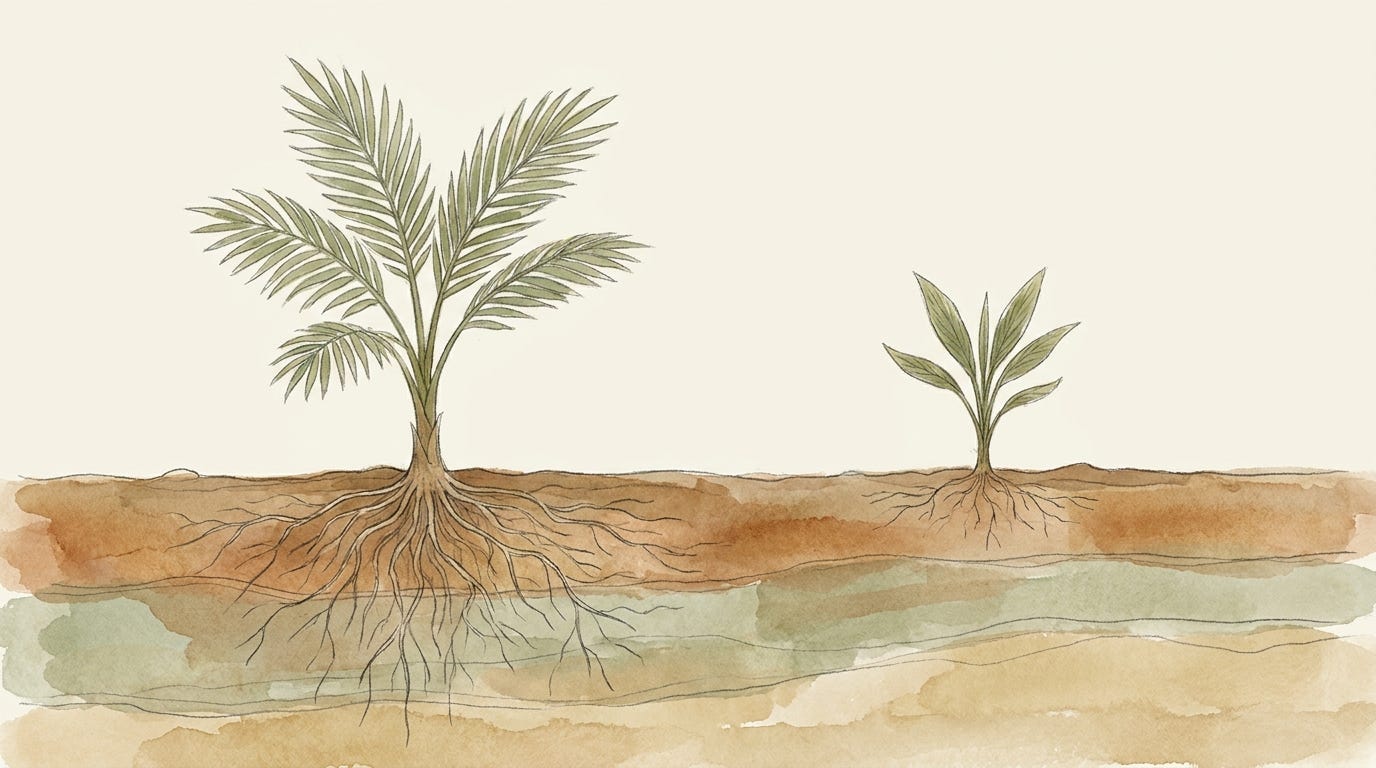
Now, here is where the comparison between people and palms breaks down, and the break is worth looking at. A palm cannot notice its own dimming. It cannot ask why the tree beside it is thriving, and it cannot do anything about its situation even if it could ask. A person can. That is the one real difference, and it changes everything about what the metaphor asks of us. Toward the parts of life that are simply slow, the invitation is patience. Our smaller palms are not defective. Whether they take two years or three to reach harvest will not matter much in the end, and I am not out there scolding them. But toward the persistent sense of going through the motions, the invitation is not patience. It is attention. Slowness is not a verdict. Dimming is a signal.
How do you tell the difference between a season that is simply slow and a life that is quietly misaligned? That question deserves some room, and I would not rush past it. What I have found is that slowness usually still has life in it. Something is moving, even if the movement is hard to see. Misalignment feels different. The effort goes out and does not connect to anything that matters to you.
As for our palms, I will keep watering all of them, the tall ones and the small ones alike, and let each grow at whatever rate is its own. I invite you to extend yourself the same care, and then to go one step further than a tree ever could. Notice where your energy rises on its own, and notice where it has gone quiet. What might those two answers be telling you? That, to me, is worth pondering.
© Dr. Doug Gulbrandsen