

Living in Thailand keeps handing me that question in new forms. Walk through almost any neighborhood here and you will find a spirit house outside a home or a shop, a small structure on a pedestal with offerings of fruit, fresh flowers, and orange soda. The practice is older in this region than Buddhism is. It sits alongside it anyway. In Bangkok, the Erawan Shrine holds a four faced image of Phra Phrom, the Thai form of the Hindu Brahma, and it is crowded every day with people who would tell you without hesitation that they are Buddhist. In neighborhoods with Chinese heritage there are temples with ancestral altars, red paper, and incense thick enough to make your eyes water, and the same families attend the Thai temple down the road.
When I first arrived, I kept trying to sort it. This one is Buddhist, that one is Hindu, this one is Chinese. I wanted the categories to hold still. They do not, and it took me embarrassingly long to notice that my need for them to hold still said more about how I was raised than about anything happening in front of me.
Most of us can remember changing our minds about something. A food we once hated, a person we misunderstood, a political idea, a career, something our parents told us that turned out not to be quite true. Changing our minds about those things is rarely threatening. But there are other beliefs we do not simply have. We become them.
Religion may be the clearest example. A child is not born knowing whether she is Catholic, Protestant, Mormon, Jewish, Buddhist, Muslim, Hindu, or none of those things. She arrives without a theology. Then the world begins explaining itself to her.
This is God.
This is what God wants.
This is what happens when you die.
These are the people who understand the truth.
This is how a good person behaves.
And most importantly: this is who you are.
Long before we are capable of examining those ideas, they become part of the architecture of the self. That is not necessarily a problem. Much of what we inherit is beautiful. We inherit language this way, along with culture, family traditions, rituals, and most of what we know about how to love another person. We could hardly begin life without borrowing from those who came before us.
The difficulty begins when something borrowed becomes so embedded in identity that examining it feels like examining ourselves. You can feel it in the body before you can name it. Someone questions the belief and your chest tightens, your jaw sets, and you are already preparing a defense before you have understood what was actually said. At that point a question is no longer a question. It has become a threat.
What Sits Underneath
I have spent much of my life interested in why people do what they do. Over time I have become less interested in behavior and more interested in what sits under it, because beneath almost every behavior is an interpretation, and beneath most interpretations is a belief. I need to succeed to be worthy. I must keep everyone happy. Conflict means something has gone wrong. Good people do not disappoint others. God expects this of me.
Most of these did not arrive after careful examination. They accumulated. A comment from a parent, an experience at school, a sermon, a disappointment, a moment of shame that lasted eleven seconds and then lived in the body for thirty years. Eventually we stop remembering where the belief came from and it simply becomes reality. Once that happens we no longer experience it as a belief at all. We experience it as the truth.
Born Into It
Christianity today contains an enormous variety of traditions, each shaped by centuries of interpretation, history, culture, councils, reformations, and disagreement. Sincere people within those traditions believe very different things about baptism, salvation, authority, scripture, heaven, communion, grace, works, and what it means to belong to Christ. That observation does not require anyone to decide which tradition is right. Something more personal interests me.
A person born into any one of them does not experience it as one interpretation among many. As a child, you experience it as Christianity. As truth. Born somewhere else, to different parents, inside another tradition entirely, a different set of beliefs would have felt just as obvious.
Here is where I have to be careful, because that argument can be pushed further than it deserves. That a belief was handed to me says nothing about whether it is true. Every person who has ever been right about anything learned it from someone. If inheritance disqualified a belief, it would disqualify the multiplication table. So the accident of birth does not settle the question of truth.
What it settles is something else, and this is the part I keep returning to. It tells me where my certainty came from. The confidence I carried was not produced by evidence I had weighed. It was produced by proximity. I believed it completely because everyone around me did, and because it was installed before I had the equipment to examine anything. A belief can be inherited and still be true. But the feeling of certainty attached to it was never evidence of anything. Those two things came apart for me and have not gone back together.
Questioning Is Not Rejecting
We assume that questioning something means we are preparing to abandon it. I do not think that is true. There is a difference between rejecting a belief and examining it, and something genuinely true should not need our fear to protect it. If I examine something I have believed for fifty years and find that it still holds, I have not weakened it. I may finally have made it my own. And if I find that part of what I believed was cultural, institutional, or simply someone else’s interpretation, releasing it is not a loss of faith. It is an act of integrity.
The older I become, the less interested I am in defending everything I once believed merely because I once believed it. I am more interested in what is true.
It Happens Well Outside Religion
We do this with far more than theology. We become the responsible one, the achiever, the caretaker, the person who never needs anything, the one who holds the family together through every holiday and every crisis. At first these are simply ways we learned to navigate life. Then something subtle happens and the behavior becomes an identity. I am the provider. I am the person everyone depends on.
After that, anything contradicting the identity starts to feel dangerous. Rest feels irresponsible. Receiving feels selfish. Setting a boundary feels like cruelty, and admitting uncertainty feels like weakness. We are no longer protecting a behavior. We are protecting the person we believe ourselves to be. This is one reason change is so hard. Sometimes the life we want requires us to disappoint the identity we have spent decades constructing.

Who Would I Be Without It?
There is a question I have come to appreciate. If I stopped believing this, who would I be?
Not yet, is this belief right or wrong. First, who would I be without it.
That question reveals something. Sometimes what we thought was conviction was also belonging. Sometimes what we called principle was partly fear, and what we called personality was adaptation. Sometimes what we defended as truth was holding together an identity we were afraid to lose. None of that makes the belief false. It explains why questioning it feels so dangerous, and that is useful information to have.
Much of the work behind the 4D Personal Portrait grew from a version of this same question. Who are you beneath adaptation, expectation, and conditioning? Not who you learned to be, not who your profession rewarded you for becoming, not who your religious community told you a good person should be. Who are you?
The question does not require discarding what we have inherited. It does the opposite. It lets us look at what we were given and consciously choose what deserves to stay. Some of it will. Probably most of it will. But it is no longer merely borrowed. It has been examined, chosen, lived.
What Remains?
I find myself asking a similar question about faith. What remains when we separate God from everything we have been told about God? I do not ask that cynically. I find the question strangely beautiful.
Beneath the theology, the institutions, the denominations, and the centuries of argument, there is a human longing that existed long before any of them. The longing to understand why we are here. The longing to know whether our lives matter. The longing to love and be loved, and to become something larger than our own fear. Our traditions sometimes help us approach those longings and sometimes obscure them, and if we are honest, most of them have done both.
Maturity may not be reaching the place where we finally possess all the answers. It may be reaching the place where the questions no longer frighten us.
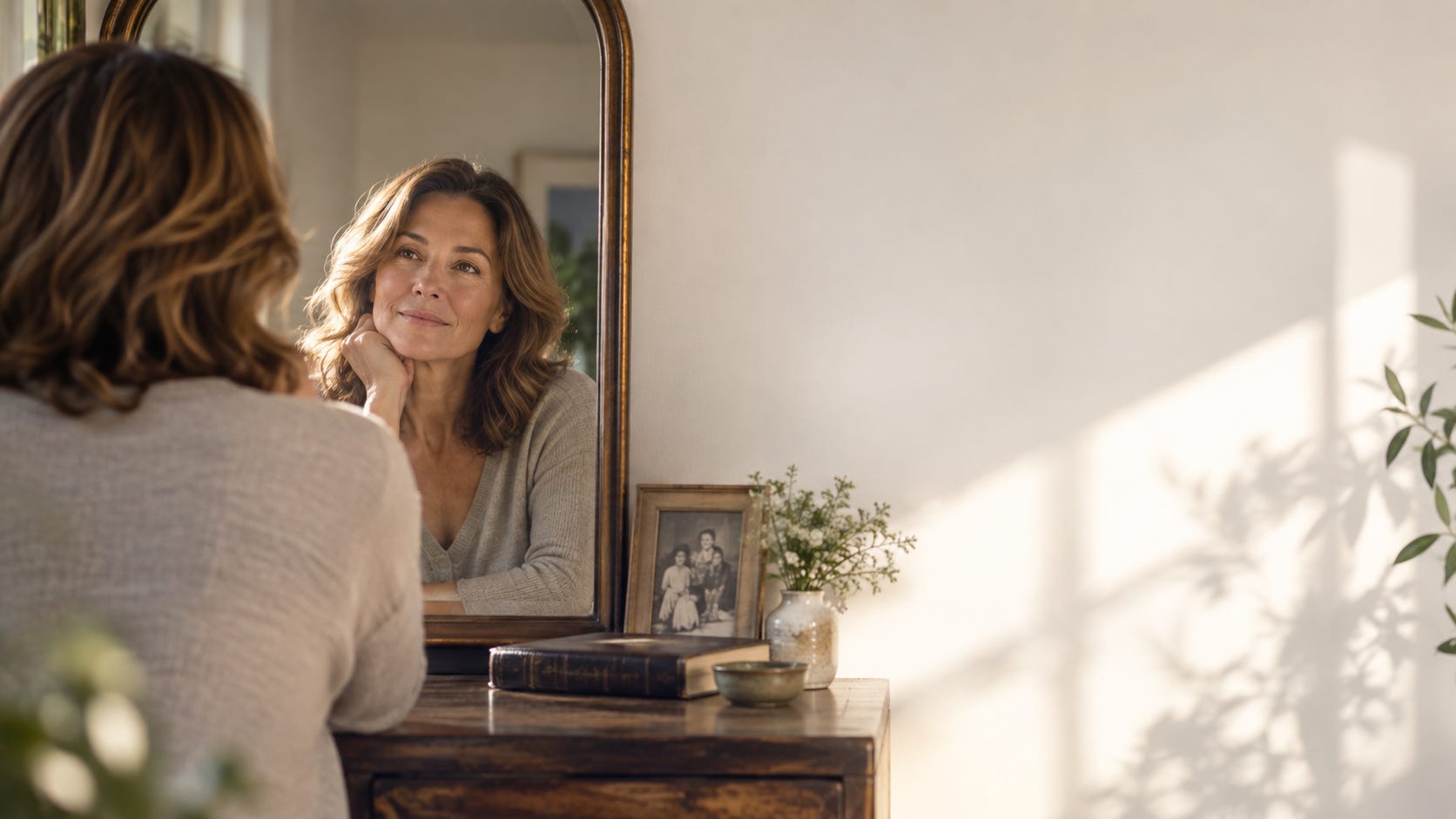
There comes a point in life when we can begin laying things on the table. Religious beliefs, assumptions about success, the roles we have played, the identities we have protected. Not to throw them out, only to look at them, and to ask gently where each one came from, whether it is true, whether it is actually mine, and whether it still leads me toward love and wholeness.
What remains after that is not emptiness. It is quieter than what we set down, and it has been there the whole time underneath the labels. Not another person to become. Someone we are finally beginning to recognize.
I am still in the middle of this. Most mornings here begin with the sound of monks walking for alms while the shops are still closed, and it strikes me that people have been reaching toward the divine in this particular way for a very long time, with no help from the categories I brought with me. I invite you to take one belief you have carried so long that you have never once examined it, and simply ask where it came from. Not to discard it. Only to see whether it is yours.
© Dr. Doug Gulbrandsen