

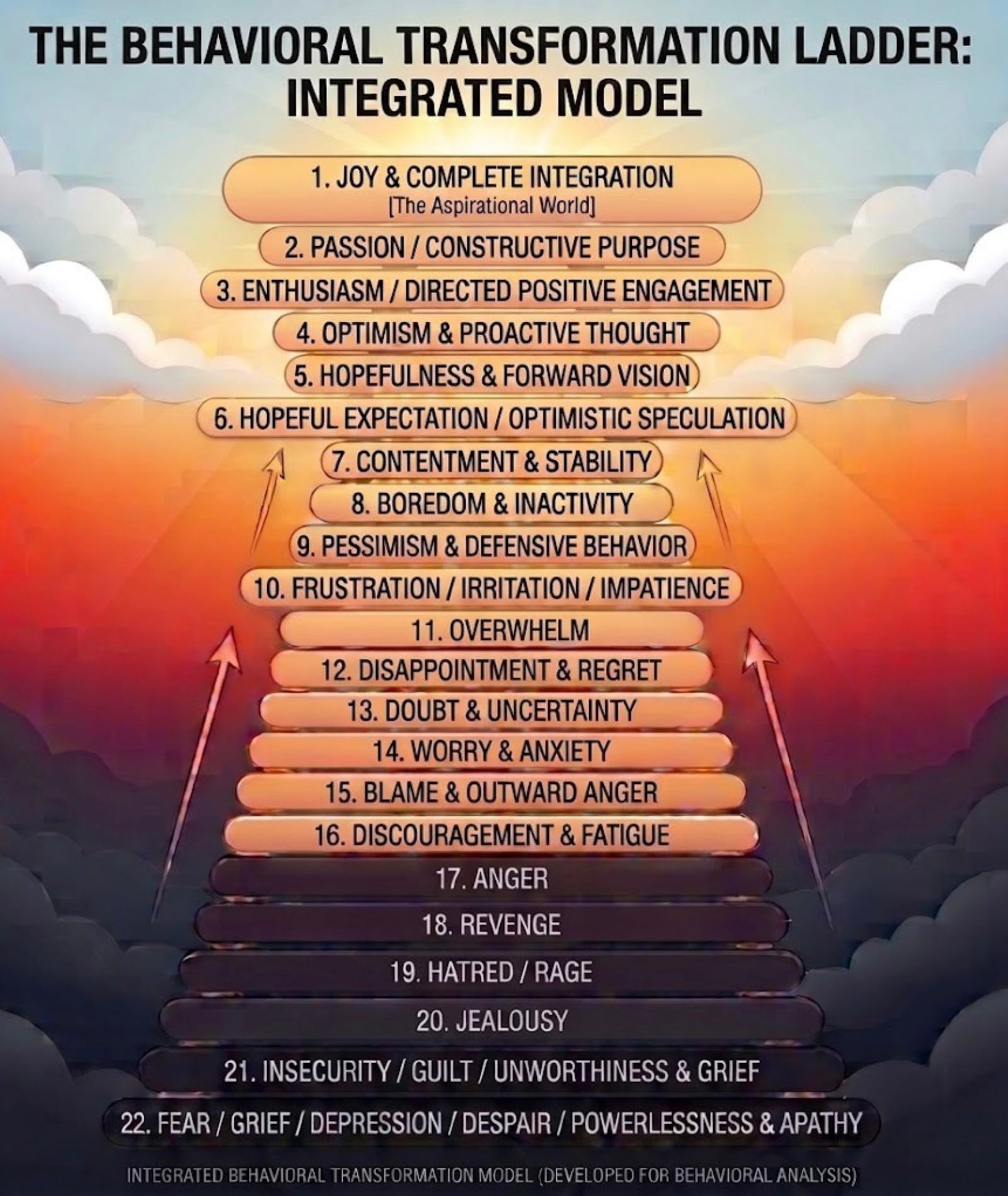
Over years of studying behavioral and emotional frameworks, I developed what I now call the Behavioral Transformation Ladder: An Integrated Model — mapping 22 emotional states, from fear, grief, and powerlessness at the bottom to joy and complete integration at the top. I return to it not as a prescription, but as a diagnostic tool. And the more I work with it, the more one question keeps rising: what if the first and most important thing is simply knowing where you are?
As of late, I have found myself sitting more often than usual at level ten — frustration, irritation, impatience. That is not where I typically live, and the fact that I noticed the shift is what got me thinking about this more carefully.
This concept has interested me for years.
Years ago, one of my sons came home from a scout camping trip visibly shaken. He had been given a leadership role within the troop, made a mistake, and his scout leader had responded by belittling him in front of the other boys. My son was hurt and confused in the way that tends to happen when an adult you respect chooses humiliation over guidance.
What I tried to explain to him was this: what he had just witnessed was not really about him. It was a window. That leader’s response almost certainly reflected where he himself was living emotionally — his default address under pressure. People who are genuinely residing at contentment or above do not typically respond to a boy’s mistake with belittlement. The situation had simply revealed something that was already there.
That, to me, is one of the most honest things about emotional states. We can manage our presentation reasonably well when life is smooth. It is the scout camping trip moments — the conflict, the frustration, the unexpected pressure — where we find out where we actually live. Not where we aspire to be. Not where we are on a careful Tuesday morning. Where we revert when the management stops.
Most people I have observed — and I include my earlier self in this — are not operating from where they think they are. They describe themselves as content, as doing well, as moving forward. And contentment, it turns out, is actually on the ladder. Level seven, to be specific. Contentment and stability. Right in the middle.
That is worth pausing on for a moment.
Level seven is not a failure. For many people, arriving at genuine contentment would be real movement. The problem is not living there. The problem is not knowing you are there, not knowing there is more available, and not knowing what is pulling you away from it without your awareness.
This is where social media enters the conversation, and I want to be honest about what I have observed. Not theoretical. Observed.
Platforms are not designed to keep you at contentment. They are designed, with considerable precision, to activate states below it. Outrage. Comparison. Anxiety. Worry about things you cannot control, reported in real time, framed to produce a response. I have watched people pick up their phones in a moment of genuine quiet and put them down several minutes later in a state they could not name but that their bodies clearly registered. The ladder had moved. They had not noticed.
And it is not only social media. I have watched people use busyness the same way, and alcohol, and noise — anything that keeps the actual emotional address just out of view. The mechanism changes. The function is the same. Stay distracted enough and you never have to answer the diagnostic question.
What I find worth considering is that none of this is a moral failure. It is a diagnostic one. If you do not know where you are, you cannot make a meaningful choice about where you want to go. And most of us were never given a map.
So what does the map suggest?
Joy sits at level one. Complete integration. It is not a performance of happiness. It is not the feeling you manufacture for a photograph. As best I can read this model, joy at the top of the ladder is the state where your inner life and your outer life are no longer in conflict. You are not managing yourself. You are not performing. You have arrived at something, and it holds.
The honest question is whether most of us actually want that, or whether we are simply accustomed to the lower rungs because they are familiar.
I think about people I have known with every external marker of success who were quietly living somewhere around level thirteen — doubt and uncertainty — without any real awareness that this was where they had set up residence. Not suffering dramatically. Just not home. Going through the motions at an address they had never consciously chosen.
The diagnostic question is simple. It is not comfortable, but it is simple: where do you actually live most of the time?
Not where you aspire to be. Not where you are on a good day. Where is your default address? And if you are honest about that, what is pulling you there, and what would it take to move?
A recent guest on my podcast offered something that has stayed with me. She suggested that the first step to moving through an emotional state is not analyzing it, not fighting it, and certainly not performing a higher one. It is simply being willing to acknowledge it. To name it honestly and let it be what it is.
That resonates with something I have observed for years. What we resist tends to persist. The energy we spend pushing an emotion away, managing it out of view, or pretending we are somewhere higher on the ladder than we actually are — that energy keeps us exactly where we are. The acknowledgment itself is what begins the movement. Not because naming something magically dissolves it, but because resistance is its own kind of anchor. When you stop pulling against where you are, something loosens.
What I have found is that clarity alone does something. When you can name where you are, without judgment, something in the nervous system settles. The pretending stops. And from that honest place, the next rung becomes visible.
Joy is not a fantasy at the top of a chart. It is what remains when the noise settles and you stop managing the distance between who you are and how you are living.
I invite you to sit with that question for a moment. Where do you actually live? And what, quietly and without pressure, might it look like to take one honest step toward home?
Note: The Behavioral Transformation Ladder is an original integrated model developed by Dr. Doug Gulbrandsen for behavioral analysis. It synthesizes the 22-step emotional sequence with Behavioral Tone Scale metrics to map specific pivot points in individual emotional momentum. The integrated model, its structure, and its application are original work.