

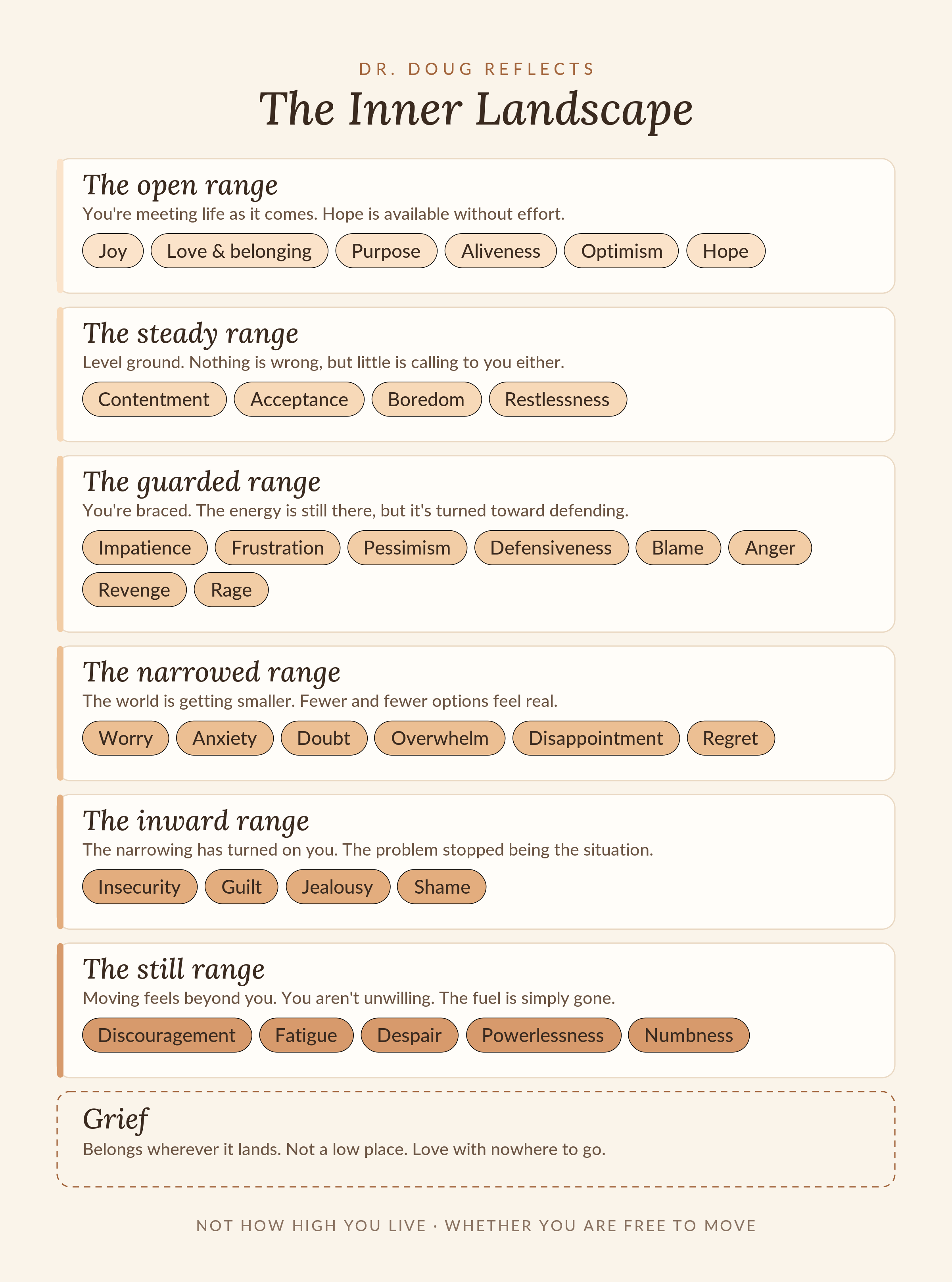
I made a chart recently that lays out the range of what a person can feel. Joy, love, and belonging near the top. Numbness, despair, and powerlessness near the bottom. Grief sits off to the side in its own dashed box, because grief refuses to belong to any single place. It shows up in a wedding as easily as a funeral.
When people look at the chart, the first thing they do is almost always the same. They locate themselves. Where am I on this. And then a quieter thought tends to follow, one that is harder to say out loud. I think I’m lower than I should be.
I want to sit with that second thought, because I believe it misreads the whole picture.
The line I placed at the bottom of the chart is the part that matters most to me. Not how high you live. Whether you are free to move. A person can pass through anger or worry or fatigue and keep moving. That is health. What quietly wears people down is not the presence of a hard feeling. It is the sense of being stuck in one, with the door painted shut. So the more useful question is not how high am I. It is can I still move from here.
Here is something I keep noticing. Most of us can manage our presentation reasonably well when life is smooth. We describe ourselves as content, as doing fine, as moving forward. It is the harder moments, the conflict and the unexpected pressure, where we find out where we actually live. Not where we aspire to be. Not where we are on a careful Tuesday morning. Where we revert when the managing stops.
Years ago one of my sons came home from a scout camping trip visibly shaken. He had been given a leadership role, made a mistake, and his scout leader responded by belittling him in front of the other boys. He was hurt and confused in the way that happens when an adult you respect chooses humiliation over guidance. What I tried to explain to him was that what he had witnessed was not really about him. It was a window. That leader’s response almost certainly reflected where he himself was living, his default address under pressure. People genuinely residing at contentment or above do not tend to meet a boy’s mistake with contempt. The situation had simply revealed something that was already there.
That, to me, is one of the more honest things about our emotional states. They are not a verdict on the people around us either. When someone meets you from the guarded range, braced and defensive, you are usually seeing their address, not your worth.
So the question turns inward. Where do you actually live most of the time?
This is where it gets interesting to me personally. When I look at where people get stuck, I rarely find that they chose the spot. More often, it was handed to them. I’ve studied religion for a long time, across a number of traditions, and one of the things I keep noticing is how much of what we carry was placed in us before we had any say in it. A child raised in a home where love arrived only after performance learns, very early, that rest is not safe. A person taught that their nature is fundamentally flawed will feel shame long before they can name why. Whole families pass anxiety down the table like it were part of dinner. Some of us have absorbed a version of God that watches and measures, and that image settles into the body as a low, constant bracing.
I want to be careful here, because I am not trying to assign blame. Most of the people who imprinted these things on us were doing their best with what they inherited. That is exactly the point. The guarded range, the narrowed range, the inward range. These are often not our native ground. They are the rooms we were placed in and told to call home.
That distinction changes what it means to be stuck. If the lower ranges were simply who you are, there would be nothing to do but accept them. But if much of what holds you there was installed by an environment, then it can be examined. Something installed can be looked at directly. And the moment you can look at it, you are already no longer fully inside it.
There is a second force worth naming, and I want to be honest that this is observed, not theoretical. A great deal in modern life is designed to keep your actual address just out of view. Social media is the clearest example. These platforms are not built to keep you at contentment. They are built, with considerable precision, to activate the ranges below it. Comparison. Outrage. Worry about things you cannot control, delivered in real time and framed to produce a response. I have watched people pick up a phone in a moment of quiet and set it down a few minutes later in a state they could not name but that their bodies clearly registered. The chart had moved. They had not noticed.
It is not only the phone. Busyness works the same way, and so does alcohol, and noise. Anything that keeps the real emotional address just out of sight. The mechanism changes and the function stays the same. Stay distracted enough and you never have to answer the honest question. None of this is a moral failure. It is a diagnostic one. Most of us were never given a map, and you cannot make a meaningful choice about where to go if you do not know where you are.
This is why I think recognition is the first real movement, not the reward at the end of a long climb. The narrowing of the world tends to feel like truth while you are inside it. Anxiety does not announce itself as anxiety. It presents itself as an accurate reading of a dangerous situation. Shame does not feel like an old imprint. It feels like the plain fact of you. The first crack of freedom comes when you can say, quietly, this feeling is real, and it may not be mine.
A recent guest on my podcast put words to something I have observed for years. The first step in moving through a state is not analyzing it, and not fighting it, and certainly not performing a higher one. It is being willing to acknowledge it. What we resist tends to persist. The energy we spend pushing a feeling out of view, or pretending we are somewhere higher on the chart than we are, is its own kind of anchor. When you stop pulling against where you are, something loosens. I have found that clarity alone does this. When you can name where you are without judgment, the nervous system settles a little, the pretending stops, and from that honest place the next opening becomes visible.
The movement upward is rarely the dramatic thing we imagine. It is not a breakthrough that resolves everything by Tuesday. It tends to be small and physical. A breath that goes lower than it has in a while. A moment of noticing that a story you tell about your life is one you learned rather than one you chose. A willingness to question an inherited belief that has never once brought you peace.
One range I would treat with extra gentleness. The still range, where the fuel is simply gone. Discouragement, despair, numbness. I don’t think that place responds to effort, and pushing on it tends to make it worse. If you find yourself there, movement may not look like climbing at all. It may look like rest, and honesty, and letting someone else sit beside you for a while. And grief, wherever it has landed, is not a low place to be fixed. It is love with nowhere to go. It deserves room, not repair.
If you want a place to start, I made a short quiz called The Inner Landscape. It takes a few minutes and tends to be more revealing than people expect. Message me if you are interested.
So I would offer this, not as instruction but as something to sit with. Find yourself on the chart honestly, without the second thought that says you should be somewhere better. Then ask where the range you’re in actually came from. Whose fear, whose home, whose idea of God or of yourself. Ask whether it was ever really yours. And notice, in your own body, whether naming it that plainly opens the door even a little.
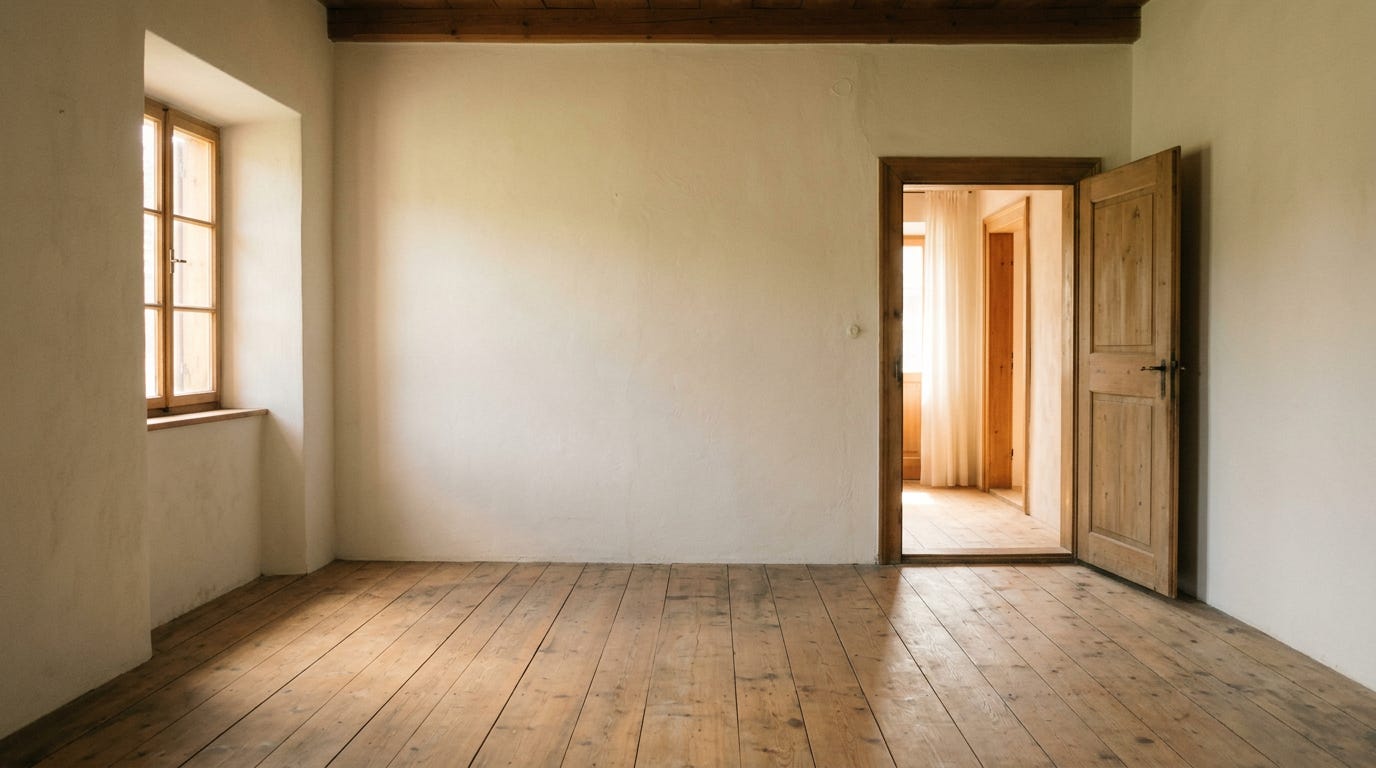
You may find you were never stuck in the way you thought. You were only standing in a room someone else built, with the key in your own pocket the whole time.
© Dr. Doug Gulbrandsen